
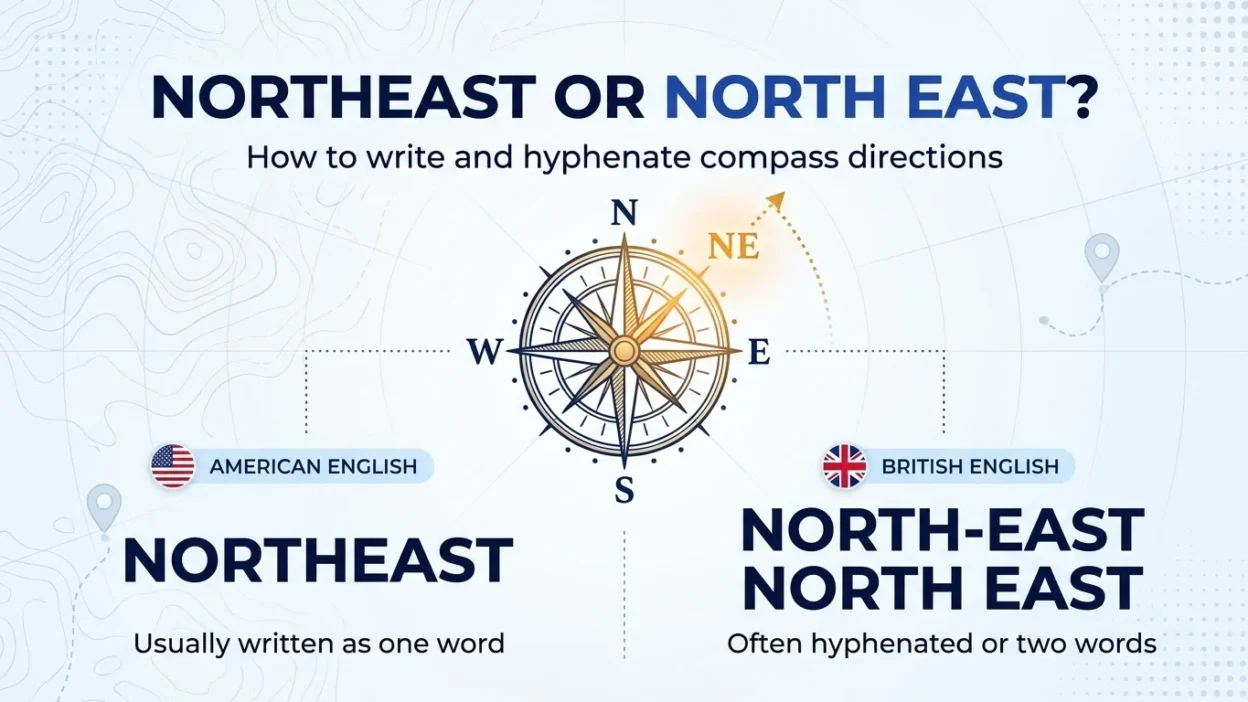
The terms northeast and north east look similar, and both refer to the direction between north and east. However, choosing the correct spelling depends on the context, writing style, and if you are following American or British English conventions. Understanding the difference can help you write more clearly and avoid common spelling mistakes.
In American English, northeast is generally the preferred spelling when referring to the compass direction, a region, or a location. In British English, north-east (with a hyphen) is also common. The two-word form north east is less standard in modern formal writing when used as a compound direction. Let’s explore their meanings, differences, grammatical uses, and practical examples.
Quick Answer: Northeast or North East?
Northeast is the standard one-word spelling in American English. It describes the direction between north and east or a region located in that area. British English commonly uses north-east with a hyphen. The two-word spelling north east is less common in standard formal writing.
Why Do People Confuse Northeast and North East?
People often confuse these spellings because they contain the same two directional words: north and east.
Both forms communicate a similar idea, but English spelling conventions determine how they should be written.
Here are three reasons for the confusion:
- Regional differences: American and British English sometimes use different spelling conventions.
- Compound words: English combines many words into one, while others remain separate or become hyphenated.
- Informal writing: People sometimes write directional expressions as separate words without considering standard spelling rules.
The important thing is to understand the context and choose the spelling that matches your preferred English variety.
What Does Northeast Mean?
Northeast is a noun, adjective, or adverb that describes the direction halfway between north and east. It represents a compass direction of approximately 45 degrees.
It can also describe a geographical region located in the northeastern part of a country or area.
Northeast as a Noun
As a noun, northeast identifies a direction or geographical region.
Examples:
- The northeast is known for its beautiful mountains.
- We traveled toward the northeast.
- The northeast of the country receives heavy rainfall.
Northeast as an Adjective
As an adjective, northeast describes something located in or coming from the northeastern direction.
Examples:
- They live in the northeast region.
- A northeast wind is blowing today.
- The northeast coast attracts many tourists.
Northeast as an Adverb
As an adverb, northeast describes movement or position toward the northeast.
Examples:
- The road continues northeast.
- We drove northeast for several hours.
- The birds flew northeast during migration.
What Does North East Mean?
North east is a two-word spelling of the same directional expression. However, it is less commonly used as a standard compound spelling in modern English.
In British English, the conventional written form is generally north-east, with a hyphen rather than a space.
The expression identifies the direction between north and east or a geographical area in that direction.
North-East as a Noun
Examples:
- The north-east is famous for its historic towns.
- They traveled toward the north-east.
- Rain is expected in the north-east.
North-East as an Adjective
Examples:
- We visited the north-east region.
- A north-east wind brought cooler weather.
- The north-east coast is popular with visitors.
North-East as an Adverb
Examples:
- The river flows north-east.
- The plane traveled north-east.
- The hikers continued north-east along the trail.
Northeast vs North East: Comparison Table
| Feature | Northeast | North East |
|---|---|---|
| Spelling | One word | Two words |
| Standard usage | American English | Less standard as a compound |
| British alternative | Northeast is understood | North-east is common |
| Meaning | Direction between north and east | Same intended direction |
| Part of speech | Noun, adjective, adverb | Intended directional expression |
| Formal writing | Preferred in American English | Usually use north-east in British English |
Remember: If you are writing in American English, choose northeast. If you are following traditional British English conventions, north-east is generally the preferred form.
When Should You Use Northeast or North East?
The correct choice depends on your audience and writing style.
1. Use Northeast in American English
American English generally combines the directional words into one word.
Examples:
- My hometown is in the Northeast.
- The storm is moving northeast.
- They explored the northeastern coastline.
2. Use North-East in British English
British English traditionally uses a hyphen in compound compass directions.
Examples:
- We traveled to the north-east.
- The north-east region has beautiful scenery.
- A north-east wind is expected tomorrow.
3. Use Northeast for Geographic Regions
When referring to a recognized geographical region, northeast is commonly written as one word in American English.
Examples:
- The Northeast has several large cities.
- She moved to the northeastern United States.
- The Northeast is famous for its changing seasons.
4. Follow the Style Guide
If you are writing an academic paper, newspaper article, business document, or website content, follow the spelling conventions of your chosen style guide.
Consistency is more important than mixing different forms throughout the same document.
12 Examples of Northeast and North-East in Sentences
Here are practical examples to help you understand how these spellings work.
- The sun rises in the east, while the northeast lies between north and east.
- We are planning a trip to the Northeast.
- The wind is blowing from the northeast.
- Their house is located in the northeastern part of the city.
- The airplane continued northeast after takeoff.
- The northeast coast is popular among tourists.
- They moved to the north-east of England.
- A strong north-east wind is expected this evening.
- The village is situated in the north-east of the country.
- The river flows north-east through the valley.
- We explored several towns in the northeastern region.
- The weather is usually colder in the northeast during winter.
These examples show that the one-word and hyphenated forms can express the same general direction, depending on the spelling convention.
Common Mistakes When Using Northeast and North East
Writers sometimes make mistakes when using compound compass directions.
Here are some common errors to avoid.
Mistake 1: Mixing Different Spellings
Incorrect or inconsistent:
- The city is in the Northeast.
- We traveled to the north east.
- The north-east region is beautiful.
Better:
Choose one spelling convention and use it consistently.
Mistake 2: Using North East in American Formal Writing
Less standard:
– They live in the north east of the country.
Better:
– They live in the northeast of the country.
Mistake 3: Forgetting the Hyphen in British English
Less conventional in traditional British usage:
– We visited the north east of England.
Preferred:
– We visited the north-east of England.
Mistake 4: Confusing Northeast With Eastern or Northern
These expressions are related but do not mean exactly the same thing.
- Northeast: Between north and east.
- Northern: Located toward the north.
- Eastern: Located toward the east.
Using the correct directional word makes your sentence more precise.
Memory Trick: How to Remember Northeast
An easy way to remember the spelling is to think of northeast as one combined compass direction.
North + East = Northeast
Remember these simple rules:
- American English: Northeast.
- British English: North-east.
- Avoid north east as a compound spelling in formal writing.
You can also remember that northeast is one of the four intermediate compass directions, alongside northwest, southeast, and southwest.
American vs British English: Northeast or North-East?
American and British English sometimes follow different conventions when combining compass directions.
| Direction | American English | British English |
|---|---|---|
| Northeast | Northeast | North-east |
| Northwest | Northwest | North-west |
| Southeast | Southeast | South-east |
| Southwest | Southwest | South-west |
In American English, these directions are generally written as single words.
In British English, hyphenated forms are traditional and widely accepted.
However, British publications and individual style guides may also use closed compounds. Always check the preferred spelling guide when writing for a particular publication.
Similar Words to Northeast
Understanding related compass directions can help you use northeast correctly.
1. Northwest
Northwest describes the direction between north and west.
Example: The plane is flying northwest.
2. Southeast
Southeast describes the direction between south and east.
Example: The storm is moving southeast.
3. Southwest
Southwest describes the direction between south and west.
Example: They traveled southwest across the desert.
4. Northeastern
Northeastern is an adjective describing something located in the northeast.
Example: She lives in the northeastern part of the city.
5. Northerly
Northerly describes something coming from or situated toward the north.
Example: A northerly wind is blowing.
6. Easterly
Easterly describes something coming from or situated toward the east.
Example: An easterly wind brought warmer air.
Final Verdict: Northeast or North East?
The correct spelling in most American English contexts is northeast. It is written as one word when referring to the compass direction, a geographical region, or a location.
In British English, north-east is a traditional and widely accepted alternative. The two-word form north east is generally less preferred in formal writing when used as a compound direction.
For everyday writing, choose the spelling that matches your audience and remain consistent throughout your text.
FAQs:
1. Is Northeast One Word or Two?
Northeast is generally written as one word in American English. It describes the direction between north and east. British English traditionally uses the hyphenated form north-east.
2. Is North East Grammatically Correct?
North east may appear in informal writing or certain contexts, but it is not the usual standard spelling for the compound compass direction. Use northeast in American English or north-east in traditional British English.
3. Is Northeast American or British English?
Northeast is the standard American English spelling. British English traditionally prefers north-east, although northeast is also increasingly used in some British publications.
4. Should Northeast Be Capitalized?
Northeast is usually lowercase when describing a general direction.
Example: We traveled northeast.
Capitalize it when it forms part of a recognized proper geographical name or a named region according to the relevant style guide.
Example: The Northeast is experiencing cold weather.
5. Is It Northeastern or North Eastern?
Northeastern is generally written as one word in American English. North-eastern is a traditional British English alternative.
Example: They live in the northeastern part of the country.
6. What Is the Difference Between Northeast and Northeastern?
Northeast identifies a compass direction or geographical region, while northeastern is an adjective describing something located in that direction.
Examples:
- The northeast is beautiful.
- The northeastern region is beautiful.
7. Is Northeast Hyphenated?
In American English, northeast is generally written without a hyphen. In traditional British English, north-east is commonly hyphenated.
Remember This
- Northeast: Standard one-word spelling in American English.
- North-east: Traditional British English spelling.
- North east: Generally less standard for the compound compass direction.
- Northeastern: Adjective describing something located in the northeast.
- Consistency: Follow your chosen English variety or publication style guide.
Conclusion
Both northeast and north-east describe the direction between north and east. The main difference is their spelling convention. American English generally uses northeast as one word, while traditional British English commonly uses north-east with a hyphen. Although north east may appear in informal writing, it is usually not the preferred form for this compound direction.
If you want to write clearly and avoid spelling confusion, use northeast for American English and north-east for traditional British English. Remembering this simple distinction will help you use compass directions correctly in everyday conversations, academic writing, and professional communication.