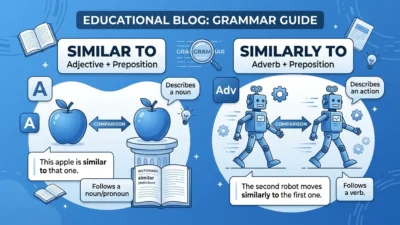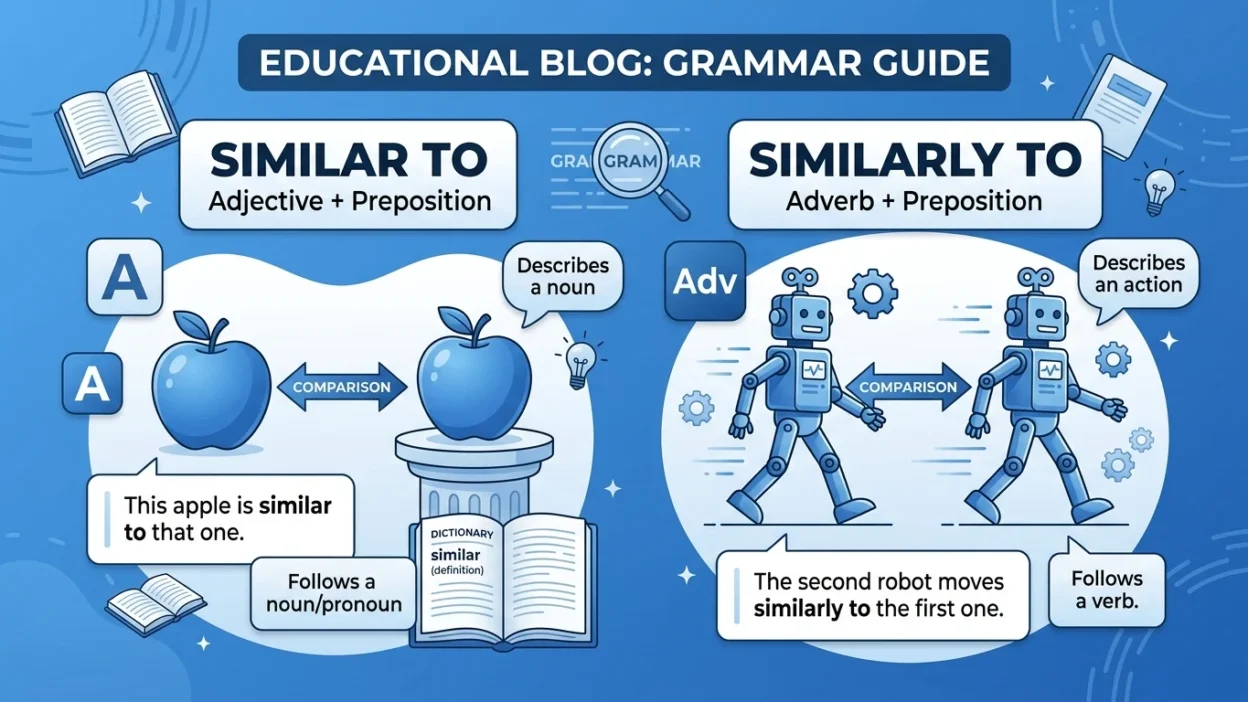
English learners often confuse similar to and similarly to because the two expressions look almost identical. However, they do different grammatical jobs. The correct choice depends on if you are describing a person or thing, or explaining how an action or situation is similar to another one.
The phrase similar to is much more common and is normally used before a noun or pronoun to show that two people, things, ideas, or situations have features in common. Similarly to is also grammatically possible, but it is an adverbial expression and is less common in everyday English. In many sentences, simply using similarly sounds more natural.
Quick Answer
Similar to is the standard and more common expression used to compare nouns, people, things, or ideas: “This phone is similar to mine.” Similarly to can introduce a comparison involving an action or situation, but it is less common. Often, similarly or like provides a more natural alternative.
Why Do People Confuse “Similar To” and “Similarly To”?
The confusion comes from the words similar and similarly. They are related, but they belong to different parts of speech.
Similar is an adjective. It describes a noun or pronoun and is commonly followed by to.
- Her dress is similar to mine.
- This problem is similar to the previous one.
Similarly is an adverb. It describes how something happens or connects one statement or action with another.
- The two teams performed similarly.
- Similarly, we can apply this rule to the second example.
When similarly to is used together, it usually creates an adverbial comparison:
- Similarly to his father, John chose a career in medicine.
Although this sentence is grammatically possible, many speakers would prefer:
- Like his father, John chose a career in medicine.
- Similarly, John chose a career in medicine.
First Word: Similar To
Similar to is an adjective phrase. It means that one person, object, idea, or situation resembles another.
The basic pattern is:
subject + be + similar to + noun/pronoun
Examples:
- My new laptop is similar to my old one.
- Your idea is similar to mine.
- This color is similar to blue.
- The two houses are similar to each other.
You can use similar to when discussing appearance, characteristics, behavior, ideas, situations, or qualities.
Examples
- Her voice is similar to her mother’s.
- This exercise is similar to the one we did yesterday.
- Their opinions are similar to ours.
Second Word: Similarly To
Similarly to combines the adverb similarly with the preposition to. It can be used to introduce a comparison between an action, person, situation, or event and another one.
For example:
- Similarly to her sister, Maria enjoys painting.
However, similarly to is not usually the first choice in everyday English. Depending on the sentence, like, as, or similarly may sound smoother.
Compare:
- Similarly to his brother, James works from home.
- Like his brother, James works from home.
The second sentence is more natural for most everyday contexts.
Similarly is especially useful at the beginning of a sentence when you want to connect two related ideas:
- Sarah studied hard for the exam. Similarly, her brother prepared carefully.
Similar To vs Similarly To: Comparison Table
| Feature | Similar to | Similarly to |
|---|---|---|
| Part of speech | Adjective phrase | Adverbial phrase |
| Main function | Describes similarity | Shows similarity between actions or situations |
| Commonness | Very common | Less common |
| Usually followed by | Noun/pronoun | Noun/pronoun or comparison |
| Example | This car is similar to mine. | Similarly to her mother, she enjoys gardening. |
| Natural alternative | — | Similarly, like, or as |
When Should You Use Each?
Use “Similar To” for Things That Resemble Each Other
Use similar to when the subject itself has qualities that resemble another person or thing.
- This book is similar to that one.
- His personality is similar to his father’s.
- The two designs are similar to each other.
This is the most common use.
Use “Similarly” to Connect Ideas or Actions
When you want to say that something happens in a similar way, similarly is often the best choice.
- Tom worked hard. Similarly, Jane gave the project her full attention.
- The first method is effective. Similarly, the second method produces good results.
Use “Similarly To” Carefully
Similarly to is possible when you want to compare a person, action, or situation with another one.
- Similarly to her classmates, Emma joined the competition.
But in many cases, like sounds more natural:
- Like her classmates, Emma joined the competition.
Or you can restructure the sentence:
- Emma joined the competition, similarly to her classmates.
Even here, like her classmates would generally be simpler.
12 Examples of “Similar To”
- This phone is similar to the one I bought last year.
- Your answer is similar to mine.
- The new design looks similar to the original.
- Her hairstyle is similar to her sister’s.
- This situation is similar to what happened yesterday.
- The two languages are similar to each other in several ways.
- My new job is similar to my previous one.
- His writing style is similar to that of his teacher.
- This recipe is similar to the traditional version.
- The symptoms are similar to those described in the report.
- Your idea is similar to something I was thinking about.
- These two products are similar to each other but not identical.
10 Examples of “Similarly” and “Similarly To”
- Similarly, the second experiment produced positive results.
- The two students performed similarly on the test.
- Similarly, we should consider the needs of younger learners.
- Similarly to her mother, Anna enjoys helping other people.
- Similarly to his colleagues, Mark decided to work remotely.
- The first company reduced its prices. Similarly, its competitor introduced discounts.
- Both teams played similarly throughout the match.
- Similarly, the second example demonstrates the same principle.
- Similarly to the previous case, this situation requires careful consideration.
- Similarly, this approach can be used in other situations.
Notice that similarly without to is often the most natural option when connecting two complete ideas.
Common Mistakes With Similar To and Similarly To
Mistake 1: Using “Similarly To” Instead of “Similar To”
Incorrect:
- This car is similarly to mine.
Correct:
- This car is similar to mine.
The adjective similar describes the car.
Mistake 2: Using “Similar” When an Adverb Is Needed
Incorrect:
- She performed similar to her teammate.
Better:
- She performed similarly to her teammate.
Here, similarly describes the way she performed.
Mistake 3: Assuming “Similarly To” Is Always More Formal
The longer phrase is not automatically better. Similarly to can sound formal or awkward when a simpler construction would work.
Instead of:
- Similarly to his father, he became a doctor.
You can naturally say:
- Like his father, he became a doctor.
Mistake 4: Forgetting That “Similar” Usually Takes “To”
A common learner mistake is saying:
- This is similar with my idea.
In standard English, the usual construction is:
- This is similar to my idea.
Memory Trick
Remember:
Similar = describes a thing.
Similarly = describes an action or connects ideas.
Think of it this way:
- Similar to → “What is alike?”
- Similarly → “How is it alike?”
For example:
My car is similar to yours.
The cars are alike.
My car performs similarly to yours.
The cars perform in a similar way.
American vs British English
There is no major American-versus-British difference in the basic use of similar to. Both American and British English commonly use similar to to describe resemblance.
For example:
- The two buildings are similar to each other.
The same is true for similarly:
- Similarly, the second study reached the same conclusion.
Similarly to can occur in both varieties of English, but it is less common than similar to and often has more natural alternatives such as like, as, or similarly.
Therefore, learners of either American or British English should focus more on grammatical function and natural sentence structure than on regional differences.
Similar Words
Several expressions can help you make comparisons without repeatedly using similar to or similarly to.
Like
Like is a very common way to compare people or things.
- Like her brother, she loves football.
Alike
Alike means similar or resembling one another.
- The two sisters look alike.
Resemble
Resemble is a verb meaning “to look or be similar to.”
- She resembles her mother.
Do not normally say:
- She resembles to her mother.
Instead:
- She resembles her mother.
In the Same Way
This phrase can replace similarly when explaining that something happens in a comparable manner.
- The second group responded in the same way.
Likewise
Likewise can mean “similarly” or “in the same way.”
- The first team performed well, and the second team did likewise.
Final Verdict: Similar To or Similarly To?
For most situations, similar to is the expression you should choose when describing how one person, thing, idea, or situation resembles another.
Use:
similar to + noun/pronoun
- The new model is similar to the old model.
Use similarly when you are describing an action or connecting two related ideas:
- The two students performed similarly.
- Similarly, the second example supports this argument.
Similarly to is grammatically possible, especially when making a direct comparison involving an action, person, or situation. However, it is less common and can sound less natural than like, as, or simply similarly.
When in doubt, similar to is usually the safer choice for describing resemblance.
FAQs:
Is “similar to” grammatically correct?
Yes. Similar to is completely correct and is the standard expression used to describe how two people, things, ideas, or situations resemble each other.
Is “similarly to” correct English?
Yes, similarly to can be grammatically correct. However, it is less common and can sound formal or awkward in some sentences. Often, like or similarly is more natural.
What is the difference between “similar” and “similarly”?
Similar is an adjective that describes a person or thing. Similarly is an adverb that describes an action or connects related ideas.
- The two cars are similar.
- The two cars performed similarly.
Should I say “similar to” or “similarly to”?
In most cases, use similar to when you are saying that one thing resembles another. Use similarly when comparing actions or connecting ideas. Use similarly to only when that structure fits the sentence naturally.
Is “similar with” correct?
Similar to is the standard construction when comparing two things.
- Correct: This design is similar to mine.
Although similar with may appear in some contexts, learners should generally use similar to.
Can “similar to” be used with a person?
Yes. You can use similar to when comparing a person with another person.
- Her personality is similar to her mother’s.
- He is similar to his brother in many ways.
What is a better alternative to “similarly to”?
Depending on the sentence, like, as, or similarly may be more natural.
- Like his father, he became a teacher.
- Similarly, he chose a career in education.
Which is more common: “similar to” or “similarly to”?
Similar to is much more common in ordinary English. It is the standard phrase for expressing resemblance. Similarly to has a narrower use and is often replaced by simpler alternatives.
Remember This
- Similar to = describes resemblance.
- Similarly = describes a similar action or connects ideas.
- Similarly to = possible, but less common.
- Like is often a more natural alternative to similarly to.
- Use similar to, not usually similar with, when making a comparison.
Conclusion
The difference between similar to and similarly to becomes easier when you focus on grammar rather than just the spelling. Similar is an adjective, so similar to is normally used to describe how one person, thing, idea, or situation resembles another. It is the most common choice for direct comparisons.
Similarly is an adverb used to describe actions or connect related statements, while similarly to can make a comparison but is less common. If you want your English to sound clear and natural, choose similar to for resemblance and similarly for related actions or ideas. When similarly to feels awkward, like is often the better alternative.

Levi Jack is a creative writer and conversation expert passionate about helping people communicate confidently. At ReplyCorner, he shares charming, witty, and engaging reply ideas that make everyday conversations more enjoyable and memorable.