
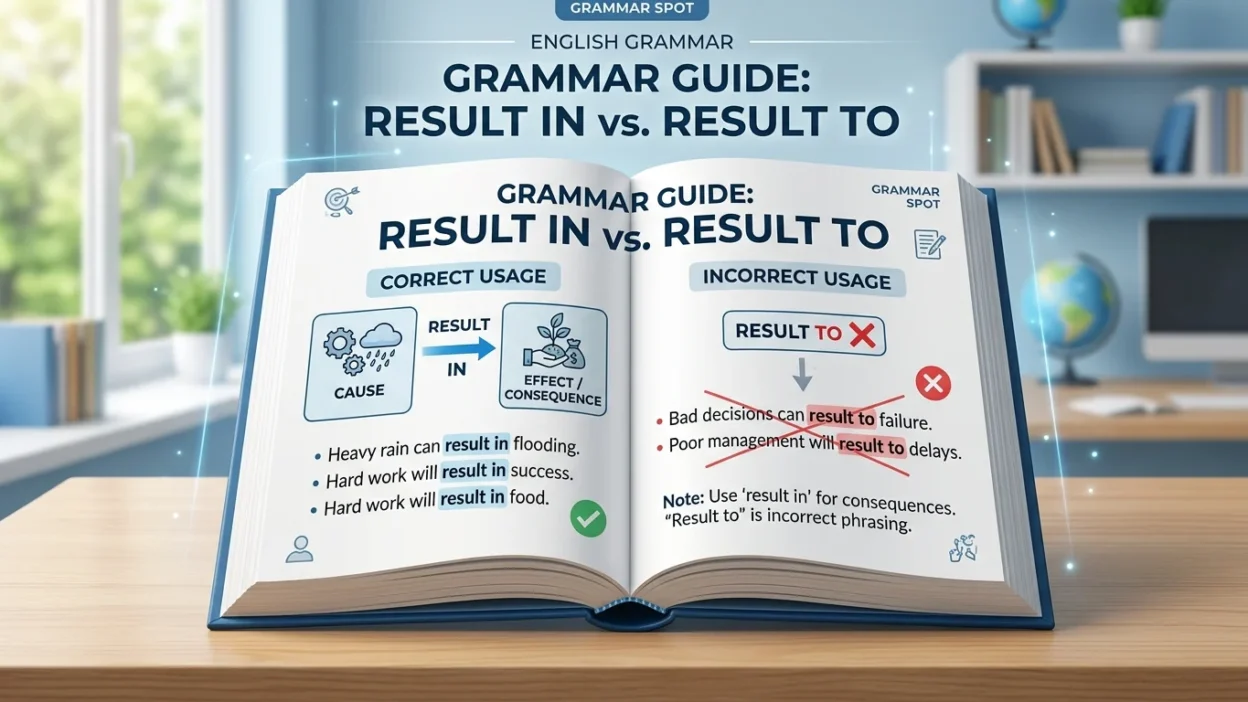
When choosing between “result in” and “result to,” the correct phrase in standard English is usually “result in.” We use result in when one thing causes or leads to a particular outcome. For example, “Poor planning can result in delays.” The phrase “result to” is generally incorrect when you want to express this cause-and-effect relationship.
This distinction can be confusing because English commonly uses several prepositions with related words, including result in, result from, and lead to. The good news is that each has a clear function. In this guide, you will learn what result in means, why result to is usually wrong, when to use each expression, and how to avoid common mistakes in everyday and academic writing.
Quick Answer
“Result in” is the correct phrase when you mean “cause” or “lead to.” For example, “Heavy rain may result in flooding.” “Result to” is not normally used for this meaning in standard English. If you want to describe the cause of a result, use result from, as in “The flooding resulted from heavy rain.”
Why Do People Confuse “Result In” and “Result To”?
The confusion usually happens because “result” and “lead” have similar meanings but take different prepositions.
We say:
- result in + outcome
- lead to + outcome
- result from + cause
For example:
- Lack of sleep can result in poor concentration.
- Lack of sleep can lead to poor concentration.
- Poor concentration can result from lack of sleep.
Because lead to is correct, some English learners incorrectly transfer the preposition to to result.
First Word: “Result In”
Result in is a standard English expression meaning to cause something to happen or to produce a particular outcome.
The structure is:
cause + result in + effect
Examples:
- Too much rain can result in flooding.
- Poor communication may result in misunderstandings.
- Regular exercise can result in better fitness.
- A small mistake could result in serious problems.
The thing before result in is the cause, while the noun or noun phrase after it is the outcome.
More Examples of “Result In”
- The accident resulted in several injuries.
- The new policy may result in higher costs.
- Careless driving can result in an accident.
- Hard work can result in better performance.
Second Word: “Result To”
Result to is generally not correct standard English when you mean that something causes an outcome.
For example:
❌ Poor planning can result to delays.
The correct version is:
✅ Poor planning can result in delays.
The confusion probably comes from the expression “lead to,” which is correct:
✅ Poor planning can lead to delays.
In standard English, remember:
result in = lead to
Not:
result to
There may be occasional nonstandard uses of result to in informal or learner English, but it should normally be avoided in careful writing.
Result In vs. Result To: Comparison Table
| Expression | Correct? | Meaning | Example |
|---|---|---|---|
| result in | Yes | Cause or produce an outcome | The error resulted in a delay. |
| result to | Usually no | Not standard for this meaning | ❌ The error resulted to a delay. |
| result from | Yes | Be caused by something | The delay resulted from an error. |
| lead to | Yes | Cause or contribute to an outcome | The error led to a delay. |
When Should You Use “Result In”?
Use result in when you are describing a cause followed by its effect.
Use “result in” for:
1. Problems
2. Changes
3. Consequences
4. Positive outcomes
5. Physical effects
The phrase can describe both negative and positive outcomes.
When Should You Use “Result From”?
Use result from when you want to identify the cause of an outcome.
Compare these sentences:
- The mistake resulted in a delay.
- The delay resulted from the mistake.
The first sentence focuses on the effect produced by the mistake.
The second sentence focuses on the cause of the delay.
This is one of the most useful distinctions to remember.
12 Examples of “Result In”
Here are practical examples showing how result in works in different contexts.
- Poor preparation can result in a weak presentation.
- Heavy snowfall may result in canceled flights.
- Lack of sleep can result in poor concentration.
- Regular reading can result in stronger vocabulary.
- The mistake resulted in a significant delay.
- Too much pressure can result in stress.
- The new rules may result in additional costs.
- Careless driving can result in serious accidents.
- Better communication can result in fewer misunderstandings.
- The investigation resulted in several important discoveries.
- A balanced diet can result in better overall health.
- The software problem resulted in the system shutting down.
Common Mistakes With “Result In”
One of the most common errors is replacing in with to.
Mistake 1: Using “result to”
❌ The decision resulted to major changes.
✅ The decision resulted in major changes.
Mistake 2: Confusing “result in” with “result from”
❌ The accident resulted in careless driving.
If you mean careless driving caused the accident, write:
✅ The accident resulted from careless driving.
Mistake 3: Using “result in” when there is no outcome
Result in normally needs an outcome after it.
❌ The problem resulted in.
✅ The problem resulted in a delay.
Mistake 4: Confusing “result in” with “lead to”
Both are correct, but their structures are different only because the verbs take different prepositions:
- result in a problem
- lead to a problem
Memory Trick: “Result IN” Means “Ends IN”
A simple way to remember the correct phrase is:
Result IN → an outcome comes IN as the result.
You can also remember this pair:
result in = lead to
For example:
- The storm resulted in flooding.
- The storm led to flooding.
Both sentences express the same basic cause-and-effect relationship.
If you see “result to” in your sentence, stop and ask:
“Do I mean ‘lead to’?”
If the answer is yes, use either lead to or result in.
American vs. British English
There is no major American-versus-British difference concerning result in.
Both American and British English commonly use:
- result in to describe an outcome
- result from to describe a cause
- lead to to describe an outcome
For example:
This construction is standard in both varieties of English.
Likewise:
So, whether you are writing for an American or British audience, result in is the safe standard choice.
Similar Words and Expressions
Several expressions are closely related to result in.
Result in
Means cause or produce an outcome.
Lead to
Also means cause or contribute to an outcome.
Cause
Directly means make something happen.
Result from
Means be caused by something.
Bring about
Means cause something to happen, often a change.
Give rise to
Means cause or create something, often a situation or problem.
Final Verdict: Result In or Result To?
The correct choice is “result in” when you mean that something causes or produces an outcome.
✅ Correct: The mistake resulted in a delay.
❌ Incorrect in standard English: The mistake resulted to a delay.
If you want to use to, choose lead to instead:
✅ The mistake led to a delay.
Also remember result from when you are identifying the cause:
✅ The delay resulted from the mistake.
The easiest rule is:
Cause → result in → effect
Effect → result from → cause
FAQs:
Is “result in” grammatically correct?
Yes. Result in is a standard English expression used when something causes or produces an outcome.
Is “result to” correct English?
Result to is generally not standard English when used to mean “cause” or “lead to.” In most cases, use result in or lead to instead.
What is the difference between “result in” and “result from”?
Result in introduces an effect, while result from introduces a cause.
Can I say “resulted to”?
Normally, no. In standard English, use resulted in when describing an outcome.
❌ The accident resulted to injuries.
✅ The accident resulted in injuries.
Is “lead to” the same as “result in”?
They have very similar meanings when describing cause and effect.
Both are correct.
Can “result in” describe a positive outcome?
Yes. Result in is not limited to negative consequences.
Which preposition follows “result”?
The correct preposition depends on the meaning:
- result in = cause an outcome
- result from = be caused by something
Result to is generally not used for these standard meanings.
Remember This
When you mean “cause” or “lead to,” use result in.
Result in + effect
When you mean “be caused by,” use result from.
Result from + cause
And when you want to use to, use lead to:
The key rule is simple:
Result in → outcome
Result from → cause
Lead to → outcome
Result to → usually incorrect
Conclusion
Choosing between result in and result to is easier once you understand the cause-and-effect pattern. Result in is the standard expression for saying that one action, event, or condition causes a particular outcome. For example, “Heavy rain can result in flooding” clearly shows the cause and its effect.
Avoid result to when writing standard English. If you want to use to, choose lead to instead. Also remember result from when you are explaining what caused an event. With these three expressions—result in, result from, and lead to—you can describe cause and effect accurately and naturally.

Levi Jack is a creative writer and conversation expert passionate about helping people communicate confidently. At ReplyCorner, he shares charming, witty, and engaging reply ideas that make everyday conversations more enjoyable and memorable.