
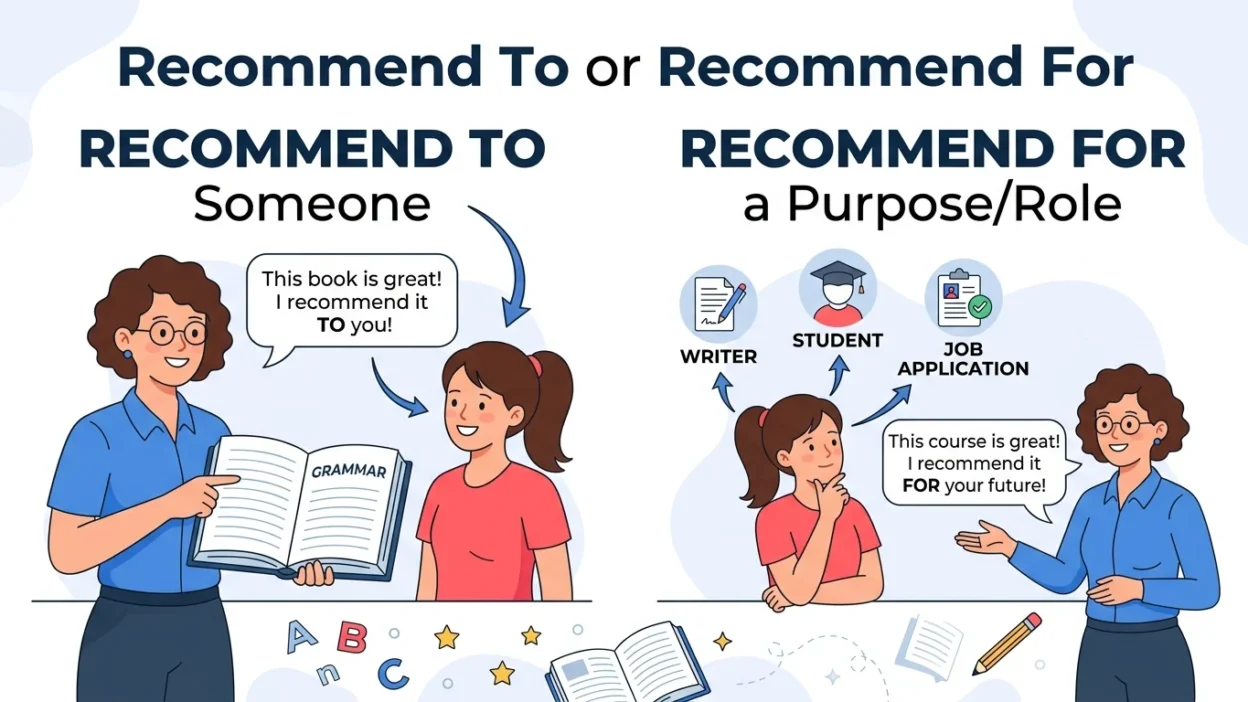
The correct choice between recommend to and recommend for depends on what you are trying to say. Use recommend to when you are talking about the person receiving a recommendation, while recommend for is generally used when someone or something is being suggested as suitable for a particular purpose, position, or role.
For example, “I recommend this book to students” is correct because students are receiving the recommendation. “I recommend Sarah for the position” is correct because Sarah is being suggested as suitable for the position.
These two expressions are easy to confuse because recommend can be followed by different prepositions depending on the meaning. Understanding the word that comes after the preposition can help you choose naturally and avoid common grammar mistakes. This guide explains recommend to or recommend for, their meanings, sentence patterns, examples, and common mistakes.
Quick Answer
Use recommend to when you identify the person or group you are giving a recommendation to: “I recommend this restaurant to my friends.” Use recommend for when you suggest someone or something as suitable for a role, purpose, treatment, or opportunity: “I recommend Maria for the job.”
Why Do People Confuse “Recommend To” and “Recommend For”?
People often confuse these expressions because both can appear after the verb recommend, but they perform different jobs in a sentence.
The preposition to usually identifies the person who receives the recommendation.
- I recommended the movie to my brother.
- She recommended the course to me.
The preposition for usually introduces a purpose, position, role, opportunity, or situation for which someone or something is considered suitable.
- They recommended James for the position.
- The doctor recommended this treatment for the patient.
A simple way to understand the difference is:
recommend something to someone
versus
recommend someone/something for something
What Does “Recommend To” Mean?
Recommend to is used when you tell another person about something that you think they should try, use, read, watch, visit, or consider.
The basic pattern is:
recommend + something + to + person
Examples:
- I recommend this book to all beginners.
- She recommended the restaurant to us.
- He recommended this movie to his friends.
- My teacher recommended the website to me.
Here, to tells us who receives the recommendation.
You can also use recommend to with an action:
- I recommended to him that he take a break.
- She recommended to us that we arrive early.
However, in everyday English, it is often more natural to say:
- I recommended that he take a break.
- She recommended that we arrive early.
What Does “Recommend For” Mean?
Recommend for is used when someone or something is considered suitable for a particular purpose, role, position, treatment, or opportunity.
Common patterns include:
recommend + person + for + position/role
- I recommend Ali for the job.
- She was recommended for promotion.
- They recommended him for the leadership position.
It can also describe suitability for a particular purpose:
- This book is recommended for beginners.
- The exercise is recommended for older adults.
- This product is recommended for outdoor use.
Notice the difference: for focuses on the purpose, role, situation, or suitability rather than simply the person receiving the recommendation.
Recommend To vs Recommend For: Comparison Table
| Expression | Main Use | Basic Pattern | Example |
|---|---|---|---|
| recommend to | Identifies who receives the recommendation | recommend + thing + to + person | I recommended the book to Sara. |
| recommend for | Shows suitability for a purpose or role | recommend + person/thing + for + purpose | I recommended Sara for the job. |
| recommended to | Something was suggested to someone | be recommended + to + person | The restaurant was recommended to me. |
| recommended for | Someone/something was considered suitable | be recommended + for + purpose/role | He was recommended for promotion. |
When Should You Use “Recommend To”?
Use recommend to when the main idea is giving advice or a suggestion to a person.
For example:
- I recommend this book to you.
- We recommended the hotel to our guests.
- She recommended the app to her sister.
Think of to as pointing toward the recipient of the recommendation.
Pattern
recommend + object + to + recipient
Examples:
- recommend a movie to a friend
- recommend a restaurant to a visitor
- recommend a product to a customer
- recommend a course to a student
When Should You Use “Recommend For”?
Use recommend for when the main idea is suitability for something.
Examples:
- recommend someone for a job
- recommend someone for promotion
- recommend someone for an award
- recommend something for children
- recommend something for beginners
Here, for connects the person or thing with a particular role, purpose, group, or situation.
12 Examples of “Recommend To”
- I recommend this book to anyone learning English.
- She recommended the new restaurant to her friends.
- My teacher recommended this website to me.
- Can you recommend a good movie to us?
- He recommended the course to his classmates.
- I recommended this app to my brother.
- They recommended the hotel to the tourists.
- Sarah recommended the podcast to me.
- The librarian recommended several novels to the students.
- My doctor recommended the exercise program to me.
- We recommended the café to our visitors.
- She recommended that book to everyone in the class.
In each example, to identifies the person or group receiving the suggestion.
12 Examples of “Recommend For”
- I recommend Sarah for the position.
- He was recommended for promotion.
- The manager recommended David for the award.
- This book is recommended for beginners.
- The course is recommended for advanced students.
- This equipment is recommended for outdoor use.
- She was recommended for the leadership role.
- The program is recommended for young learners.
- I would recommend him for the position.
- This activity is recommended for families.
- The candidate was recommended for the scholarship.
- This type of exercise is recommended for older adults.
In these examples, for introduces the role, purpose, group, or situation involved.
Common Mistakes With “Recommend To” and “Recommend For”
Mistake 1: Using “for” for the recipient
Incorrect:
- I recommend this book for John.
This can sometimes have a different meaning, such as saying the book is suitable for John. But if you simply mean that you suggested the book to John, use to.
Better:
- I recommend this book to John.
Mistake 2: Using “to” for a job position
Incorrect:
- I recommend Sarah to the position.
Better:
- I recommend Sarah for the position.
When someone is being suggested as a candidate for a role, for is normally the natural choice.
Mistake 3: Confusing the recipient with the purpose
Compare:
- I recommended the course to Tom.
- I recommended the course for beginners.
In the first sentence, Tom receives the recommendation.
In the second sentence, beginners are the group for whom the course is considered suitable.
Mistake 4: Using the wrong structure with “recommend”
A common mistake is:
- I recommend you to try this book.
In standard English, a more natural structure is:
- I recommend that you try this book.
- I recommend trying this book.
Another natural pattern is:
- I recommend this book to you.
A Simple Memory Trick
Remember:
TO = the person receiving the recommendation
FOR = the purpose, role, or suitability
Think:
For example:
- I recommend this movie to you.
- I recommend John for the job.
This simple distinction will help you choose the correct preposition in most everyday situations.
American vs British English
The basic distinction between recommend to and recommend for is generally the same in American and British English.
Both varieties commonly use:
- I recommend this book to you.
- She recommended him for the position.
- This course is recommended for beginners.
There can be differences in vocabulary and style between American and British English, but there is no major regional rule that makes recommend to correct in one variety and recommend for correct in the other.
The meaning and sentence structure matter more than the variety of English being used.
Similar Words and Expressions
Several other expressions are related to recommend and can help expand your vocabulary.
Suggest
Suggest means to put forward an idea or possibility.
- I suggest trying the new restaurant.
Advise
Advise means to give someone guidance about what they should do.
- I advised him to wait.
Endorse
Endorse means to publicly or officially support someone or something.
- The organization endorsed the candidate.
Nominate
Nominate means to officially propose someone for a position, award, or honor.
- She was nominated for the award.
Refer
Refer can mean directing someone to another person, service, or source.
- The doctor referred me to a specialist.
These words overlap with recommend, but they are not always interchangeable.
Final Verdict: Recommend To or Recommend For?
Both recommend to and recommend for are correct, but they have different meanings.
Use recommend to when you are saying who receives the recommendation:
- I recommend this book to my students.
Use recommend for when you are saying what role, purpose, opportunity, or situation someone or something is suitable for:
- I recommend John for the position.
The easiest rule is:
TO = recipient
FOR = purpose, role, or suitability
Once you focus on what comes after the preposition, the difference becomes much easier to understand.
FAQs:
Is “recommend to” grammatically correct?
Yes. Recommend to is grammatically correct when to identifies the person or group receiving a recommendation. For example: “I recommend this restaurant to my friends.”
Is “recommend for” grammatically correct?
Yes. Recommend for is correct when you are describing suitability for a purpose, position, role, opportunity, or group. For example: “She was recommended for the position.”
Should I say “recommend this to me” or “recommend this for me”?
Both can be correct, but they mean different things. Recommend this to me means someone suggests something to you. Recommend this for me means someone considers it suitable for you or your needs.
Is it “recommend to someone” or “recommend someone”?
Both structures are possible. You can say, “I recommend this book to Sarah,” or “I recommend Sarah for the position.” The correct structure depends on if you are identifying a recipient or a purpose/role.
Is “recommend someone to a job” correct?
Usually, recommend someone for a job is the natural expression when you mean that the person is a suitable candidate. For example: “I recommend James for the job.”
Can I say “I recommend you to try it”?
This structure is generally not the best choice in standard English. More natural alternatives are “I recommend that you try it” and “I recommend trying it.”
What is the difference between “recommended to” and “recommended for”?
Recommended to normally identifies the person who receives a recommendation, while recommended for identifies the purpose, role, or situation for which someone or something is considered suitable.
Remember This
Recommend TO someone = give a suggestion to that person.
Recommend FOR something = suggest someone or something as suitable for a role, purpose, or situation.
Examples:
- I recommend this book to you.
- I recommend Sarah for the job.
- This course is recommended for beginners.
- He recommended the restaurant to his friends.
Conclusion
Understanding recommend to or recommend for becomes much easier when you focus on the function of the preposition. Use to when you identify the person or group receiving a recommendation. Use for when you describe a purpose, role, position, opportunity, or situation for which someone or something is suitable.
When in doubt, remember the two basic patterns: recommend something to someone and recommend someone or something for a purpose. With a little practice, these structures will become natural, and you will be able to use them confidently in both everyday and professional English.

Levi Jack is a creative writer and conversation expert passionate about helping people communicate confidently. At ReplyCorner, he shares charming, witty, and engaging reply ideas that make everyday conversations more enjoyable and memorable.