The words farther and further are easy to confuse because both can describe something that is more distant or that goes beyond a particular point. They sound similar, and in everyday English, their meanings sometimes overlap. However, there is a useful distinction that can help you choose the right word, especially in formal writing.
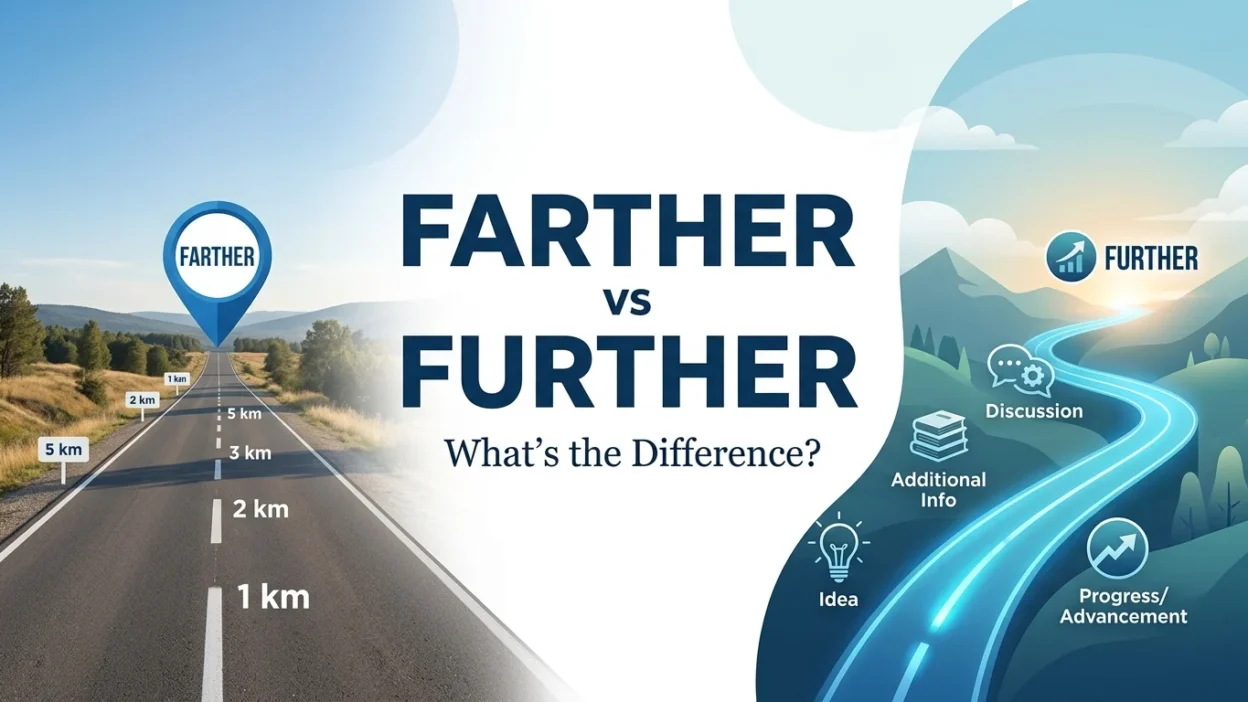
Generally, farther is traditionally used for physical distance, while further is commonly used for figurative distance, additional information, or something beyond an existing point. For example, “The store is farther down the road” refers to physical distance, while “We need to discuss this further” refers to continuing a discussion. Understanding this simple difference can make your English clearer and more precise.
Quick Answer: Farther vs Further
Farther traditionally refers to measurable physical distance, such as walking farther down a road. Further usually refers to figurative distance, additional progress, or something more, such as “further discussion.” In modern English, especially American English, further can also be used for physical distance.
Why Do People Confuse Farther and Further?
People confuse farther and further because both words are comparative forms related to the idea of going beyond a point.
They can sometimes be used interchangeably, particularly when talking about distance. For example:
- “How much farther is the station?”
- “How much further is the station?”
Both sentences are commonly understood to ask about additional distance.
The traditional distinction is more useful when you want to be precise:
- Farther → physical or measurable distance
- Further → figurative distance, additional amount, progress, or information
A simple way to remember this is that farther contains far, which is strongly associated with physical distance.
What Does Farther Mean?
Farther is traditionally used as the comparative form of far when referring to physical distance.
It answers questions such as “How much more distance?” or “Which one is more physically distant?”
For example:
Here, the word farther describes an actual physical distance between the house and the school.
More examples include:
- We walked farther than we planned.
- The airport is farther away than the train station.
- She threw the ball farther than I did.
- How much farther do we have to drive?
- The mountain looks farther away from here.
What Does Further Mean?
Further can mean more, additional, to a greater extent, or beyond a particular point.
It is especially common when discussing ideas, discussions, progress, information, actions, or abstract concepts.
For example:
Here, further does not describe physical distance. It means additional information.
Other examples include:
- We need further evidence.
- Let’s discuss this further.
- Further research is necessary.
- Please contact us for further details.
- The company made further improvements.
Farther vs Further: Comparison Table
| Feature | Farther | Further |
|---|---|---|
| Basic meaning | More distant | More, additional, or beyond |
| Traditional use | Physical distance | Figurative or abstract distance |
| Measurable distance | Yes | Sometimes |
| Additional information | No | Yes |
| Further discussion | No | Yes |
| Physical movement | Common | Also possible in modern usage |
| Example | “The shop is farther away.” | “We need further information.” |
| Memory clue | Contains “far” | Think “additional” |
When Should You Use Farther?
Use farther when you are talking about a physical distance that can usually be measured.
Physical distance
The distance exists in the physical world.
Travel
The sentence describes actual movement over a physical distance.
Objects
The ball traveled a measurable physical distance.
Location
The word describes where the restaurant is physically located.
When Should You Use Further?
Use further when you mean additional, more, to a greater extent, or beyond the current point.
Additional information
This means “Please provide additional details.”
More discussion
This means the discussion should continue.
Additional action
This means no additional action is necessary.
Progress
Here, further refers to progress rather than simple physical distance.
Farther vs Further: 12 Examples
The easiest way to understand the difference is to compare the words in real sentences.
1. Physical travel
Farther:
“We walked farther than we did yesterday.”
The sentence describes physical movement.
2. Additional discussion
Further:
“We should discuss the issue further.”
The sentence refers to continuing a discussion.
3. Physical location
Farther:
“The library is farther from my house.”
The word describes physical distance.
4. Additional information
Further:
“Please contact me if you need further information.”
Here, further means additional.
5. Throwing distance
Farther:
“He can throw the ball farther than me.”
The ball travels a physical distance.
6. Additional research
Further:
“Further research may be necessary.”
This means more research may be necessary.
7. Driving
Farther:
“How much farther do we need to drive?”
The question concerns physical distance.
8. Continuing an argument
Further:
“I don’t want to take this argument any further.”
Here, further means beyond the current stage.
9. Physical movement
Farther:
“The runner went farther than everyone else.”
The runner covered more physical distance.
10. Additional changes
Further:
“We need to make further changes to the plan.”
The meaning is additional changes.
11. Distance and direction
Farther:
“The village is farther north.”
The word can describe greater physical distance.
12. Progress
Further:
“She wants to further her education.”
Here, further functions as a verb meaning to advance or develop something.
Common Mistakes With Farther and Further
One common mistake is using farther when you mean additional.
Incorrect:
Correct:
Another common mistake is assuming further can never describe physical distance. In modern English, it can.
For example:
This usage is widely accepted, especially in everyday speech.
A useful approach is to remember the traditional distinction without treating it as an absolute rule for every variety of English.
Memory Trick for Farther and Further
The easiest memory trick is:
Farther = physical distance
Think:
If you can imagine measuring the distance with a ruler, map, odometer, or walking route, farther is a natural choice
Further = additional or abstract
Think:
If you mean more information, more discussion, more progress, or an additional action, use further.
For example:
- Walk farther.
- Drive farther.
- Run farther.
- Discuss it further.
- Investigate further.
- Provide further details.
Farther vs Further in American and British English
The traditional distinction between farther and further exists in both American and British English, but actual usage is flexible.
In American English, further is commonly used for both figurative and physical distance. For example:
This sounds completely natural to many American English speakers.
Farther is still commonly used for physical distance:
In British English, further is also frequently used for physical distance, although the traditional distinction remains useful in careful writing.
Therefore, you should not assume that using further for physical distance is automatically wrong. Context and style matter.
Similar Words to Farther and Further
Several related words can help you express distance, progress, or additional information more precisely.
Far
Far describes a large distance.
Farthest
Farthest is the superlative form traditionally associated with physical distance.
Furthest
Furthest is commonly used for the greatest degree, extent, or additional progress.
In modern usage, furthest can also appear in discussions of physical distance.
Beyond
Beyond means farther than or outside a particular point, limit, or range.
Distant
Distant describes something located far away.
Additional
Additional means extra or more.
This is closely related to one important meaning of further.
Final Verdict: Farther or Further?
The simplest rule is:
Use farther for physical distance and further for additional or figurative meanings.
For example:
- “We walked farther than expected.”
- “We need further information.”
- “How much farther is the station?”
- “Let’s discuss this further.”
However, remember that further is also widely used for physical distance in modern English. So, “How much further?” is perfectly natural in many contexts.
If you are writing formal or carefully edited English and the distinction matters, choosing farther for measurable physical distance and further for abstract or additional meanings is a reliable guideline.
FAQs:
Is farther for physical distance and further for everything else?
Traditionally, yes. Farther is associated with physical distance, while further is associated with additional amounts, progress, or figurative distance. However, further is also widely used for physical distance in modern English.
Is it correct to say “further away”?
Yes. Further away is common and accepted English.
You may also see farther away, particularly when emphasizing physical distance.
Which is correct: farther or further down the road?
Both can be used. Farther down the road follows the traditional distinction because it describes physical distance. Further down the road is also very common and can sound natural in everyday English.
Is “further information” correct?
Yes. Further information means additional information and is a standard expression.
Is “farther discussion” correct?
No, not in standard usage. When you mean additional or continued discussion, use further discussion.
What is the difference between furthest and farthest?
Traditionally, farthest is associated with physical distance, while furthest is associated with degree, extent, or figurative meaning. Modern English also uses furthest for physical distance, so the distinction is not absolute.
Can further be used for physical distance?
Yes. Further is commonly used for physical distance, particularly in everyday English. For example:
How can I remember farther vs further?
Remember farther = far + physical distance. Use further when you mean additional, more, or a greater degree of progress or discussion.
Remember This
Farther → traditionally used for physical distance.
Further → commonly means additional, more, or beyond.
Examples:
- Walk farther.
- Drive farther.
- Throw farther.
- Ask for further information.
- Discuss it further.
- Conduct further research.
- Take the matter further.
When talking about physical distance, farther is the safest traditional choice. When talking about additional information, discussion, action, or progress, further is the right choice.
Conclusion
Understanding farther vs further becomes much easier when you focus on the type of distance involved. Farther traditionally describes measurable physical distance, while further usually describes something additional, continued, or abstract. This distinction works well in most formal and everyday situations.
At the same time, modern English allows some overlap, especially with physical distance. Further is widely used in expressions such as “further down the road” and “how much further?” So, you do not need to treat every use of further for distance as an error. When in doubt, remember farther for physical distance and further for additional or figurative meaning.