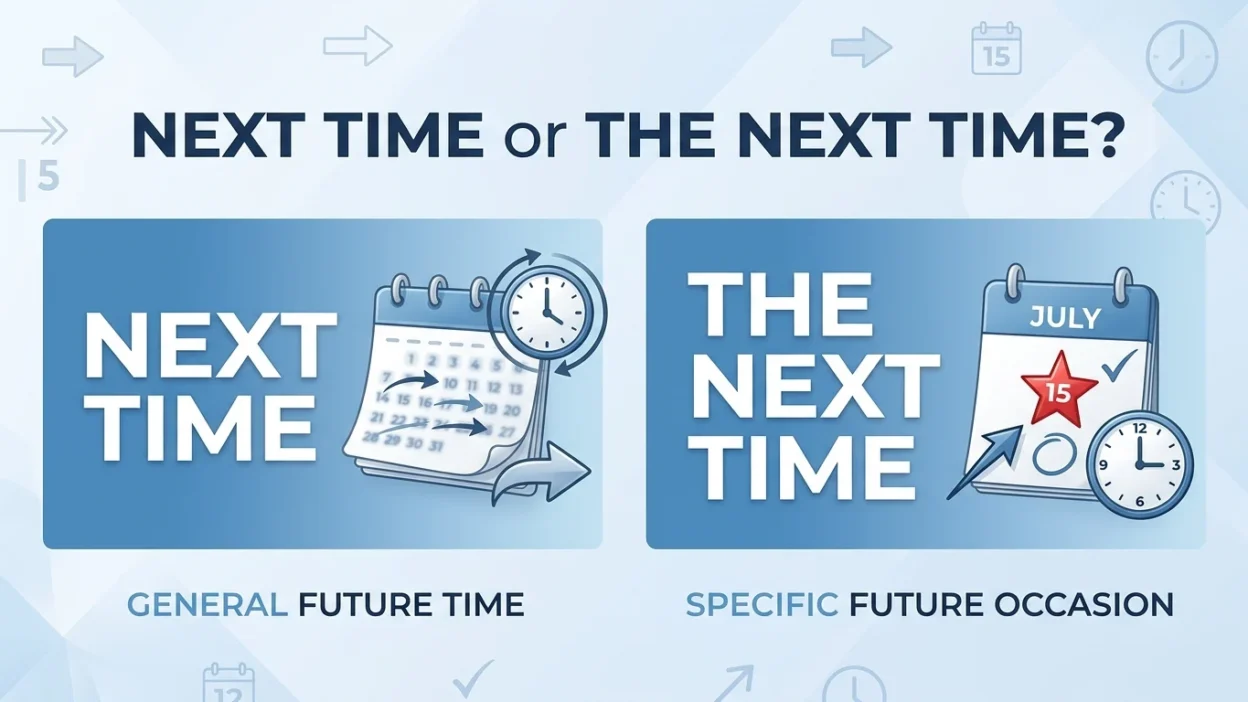
If you are unsure if to say “next time” or “the next time,” you are not alone. Both expressions are correct, but they are used in different situations. The main difference is that “next time” usually refers to a future occasion in general, while “the next time” usually refers to a specific future occasion connected to something else.
For example, you can say, “I’ll be more careful next time” when talking generally about your future attempt. But you would say, “The next time I visit London, I’ll see my cousin” when identifying a particular occasion. Understanding this small difference can make your English sound more natural and precise. This guide explains when to use each expression, provides practical examples, and covers common mistakes.
Quick Answer
“Next time” is normally used for a future occasion without the: “I’ll remember next time.” “The next time” is used when you mean a particular future occasion, often followed by a clause: “The next time I see her, I’ll tell her.” Both forms are grammatically correct.
Why Do People Confuse “Next Time” and “The Next Time”?
People often confuse these expressions because both refer to an occasion that happens after the present one.
The difference is mainly about how specifically you identify that occasion.
- Next time = the future occasion in general
- The next time = a particular future occasion, often defined by what happens during it
Compare:
- I’ll call you next time.
- The next time I call you, I’ll explain everything.
The first sentence focuses on the future occasion generally. The second identifies a specific occasion: the occasion when the speaker calls again.
What Does “Next Time” Mean?
“Next time” refers to a future occasion or opportunity, especially when the exact occasion does not need to be identified.
It is very common in everyday English.
Examples
- I’ll be more careful next time.
- Next time, we should leave earlier.
- Remember to bring your umbrella next time.
- I’ll try the chocolate cake next time.
- Next time, let’s take the train.
Here, next time works naturally without the.
What Does “The Next Time” Mean?
“The next time” refers to a particular future occasion that can usually be identified from the context.
It is especially common before a clause beginning with when, although the structure is often simply “the next time + subject + verb.”
Examples
- The next time I visit you, I’ll bring a gift.
- The next time you see him, tell him to call me.
- The next time it rains, we’ll stay home.
- The next time she comes here, we’ll talk about it.
In these examples, the phrase identifies a particular occasion.
“Next Time” vs. “The Next Time”: Comparison Table
| Expression | Main meaning | Typical use | Example |
|---|---|---|---|
| next time | A future occasion in general | Advice, promises, suggestions | I’ll do better next time. |
| the next time | A specific future occasion | A particular event or situation | The next time I see you, I’ll tell you. |
| next time + clause | Usually less common | Informal future reference | Next time we meet, let’s talk. |
| the next time + clause | A clearly identified future occasion | Very common | The next time we meet, I’ll bring the documents. |
When Should You Use “Next Time”?
Use “next time” when you are talking about a future occasion generally.
It is especially natural when giving advice, making a promise, or suggesting a different action.
Common patterns
Next time + statement
- Next time, be more careful.
- Next time, I’ll arrive earlier.
… next time
- I’ll remember next time.
- We can try that restaurant next time.
- Please check your work next time.
When Should You Use “The Next Time”?
Use “the next time” when you are referring to a particular future occurrence.
A common structure is:
the next time + subject + verb
For example:
- The next time I see John, I’ll ask him.
- The next time you come over, we’ll cook together.
- The next time she calls, answer the phone.
Here, the next time means something like “on the following occasion when this happens.”
12 Examples of “Next Time” and “The Next Time”
- I’ll remember next time.
This refers generally to a future occasion. - Next time, I’ll bring my camera.
The speaker promises to do something differently in the future. - Try the pasta next time.
This is a general suggestion for a future visit. - Be more careful next time.
The speaker is giving advice about a future occasion. - The next time I visit Paris, I’ll stay longer.
This identifies the particular future visit to Paris. - The next time you call, leave a message.
This refers to the specific occasion when the person calls again. - We’ll discuss it next time.
The exact future occasion is not specified. - The next time we meet, I’ll give you the book.
The meeting that follows the current one is specifically identified. - I’ll order something different next time.
This means on a future occasion. - The next time it happens, tell me immediately.
The phrase identifies the next occurrence of an event. - Next time, let’s take a taxi.
This is a suggestion for a future occasion. - The next time I go there, I’ll take some pictures.
This refers specifically to the speaker’s next visit there.
Common Mistakes
Mistake 1: Adding “the” unnecessarily
❌ I’ll do better the next time.
This can be grammatical in some contexts, but if you are simply making a general statement about future performance, “next time” is more natural.
✅ I’ll do better next time.
Mistake 2: Avoiding “the” before a specific occasion
❌ Next time I see her, I’ll tell her.
This sentence can actually be acceptable in informal English. However, “the next time I see her” makes the specific occasion clearer.
✅ The next time I see her, I’ll tell her.
Mistake 3: Thinking “next time” is always wrong before a clause
Next time can appear before a clause, particularly in conversational English:
- Next time we meet, let’s have lunch.
However, the next time is often clearer when you want to identify the particular occasion:
- The next time we meet, let’s have lunch.
Memory Trick
A simple way to remember the difference is:
Next time = future occasion generally.
The next time = a particular occasion you can identify.
Think of “the” as pointing to a specific occasion.
- I’ll try again next time.
- The next time I try, I’ll use a different method.
American vs. British English
There is no major difference between American and British English in the basic use of “next time” and “the next time.”
Both varieties commonly use:
- I’ll be more careful next time.
- The next time I see him, I’ll tell him.
The distinction is primarily grammatical and contextual rather than a major difference between American and British usage.
Similar Words and Expressions
Several expressions are related to next time and the next time.
Next
Next can refer to something that follows the present situation.
- See you next week.
- I’ll call you next month.
The next
The next identifies a particular item or occasion that follows another.
- The next meeting starts at 10 a.m.
- The next train arrives in five minutes.
Another time
Another time means a different or future occasion.
- Let’s discuss this another time.
Last time
Last time refers to the previous occasion.
- I saw her last time we visited.
Every time
Every time refers to all occasions.
- He smiles every time I see him.
Final Verdict
Both “next time” and “the next time” are correct.
Use “next time” when referring to a future occasion generally:
Use “the next time” when referring to a particular future occasion, especially when it is followed by a clause:
The choice depends on if you are making a general reference to the future or identifying a particular occasion.
FAQs:
Is “next time” grammatically correct?
Yes. “Next time” is grammatically correct and extremely common in everyday English. For example: “I’ll be more careful next time.”
Is “the next time” grammatically correct?
Yes. “The next time” is also correct. It commonly refers to a specific future occasion: “The next time I visit, I’ll stay longer.”
Should I say “next time” or “the next time”?
Use “next time” for a general future occasion. Use “the next time” when identifying a particular occasion, especially with a following clause.
Can I say “next time I see you”?
Yes. “Next time I see you” is common and natural, especially in conversational English. “The next time I see you” is also correct and can make the reference more explicit.
Is “the next time” more formal than “next time”?
Not necessarily. The choice is mainly based on meaning and sentence structure, not formality.
Can “next time” start a sentence?
Yes. For example: “Next time, let’s arrive earlier.” It is a natural way to make a suggestion or talk about a future occasion.
What is the difference between “next time” and “another time”?
“Next time” normally refers to the following relevant occasion, while “another time” means some different or future occasion without necessarily specifying that it is the next one.
Remember This
- Next time = a future occasion in general.
- The next time = a particular future occasion.
- Next time, I’ll be careful.
- The next time I visit, I’ll call you.
- Both expressions are correct.
- Choose the form that best matches the meaning you want to express.
Understanding this small distinction can make your English more precise and natural. When you are simply talking about what you will do on a future occasion, “next time” is usually the natural choice. When you want to identify the specific occasion that follows another event, “the next time” is often the clearer option.
The important point is not to memorize one expression as correct and the other as incorrect. Both are useful in everyday English, and the surrounding sentence usually tells you which form fits best. Once you recognize if you mean a general future occasion or a particular one, choosing between “next time” and “the next time” becomes much easier.