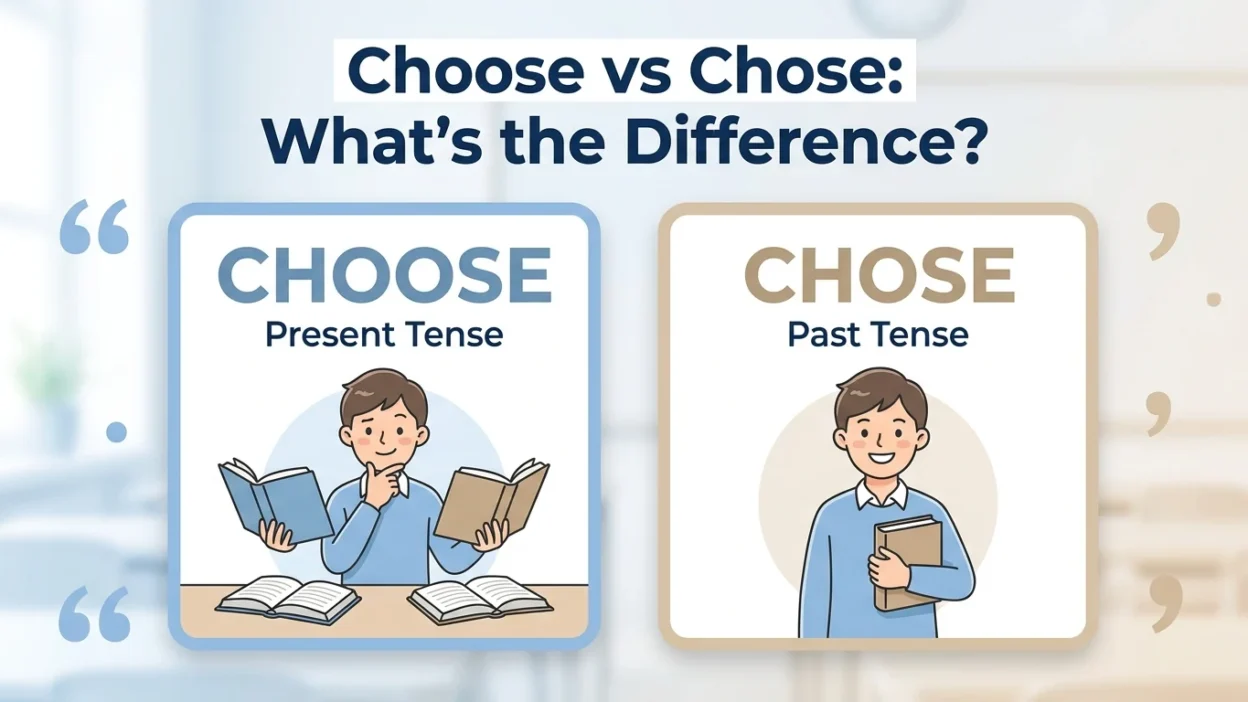
Many English learners confuse choose and chose because they are forms of the same verb. The main difference is simple: choose is the present-tense form, while chose is the past-tense form. Knowing when an action happens will usually tell you which word to use.
Use choose when talking about a decision you make now, regularly, or in the future. Use chose when talking about a decision that was already made in the past. For example, “I choose tea every morning” describes a usual choice, while “I chose tea yesterday” describes a completed past decision. This small tense difference is important in everyday conversation, writing, schoolwork, and professional English.
Quick Answer
Choose is the present form of the verb and means to select or decide between options. Chose is the simple past form of choose. Say “I choose this one” for a present decision and “I chose this one yesterday” for a past decision.
Why Do People Confuse Choose and Chose?
People often confuse choose and chose because they come from the same irregular verb:
- Choose → present tense
- Chose → past tense
- Chosen → past participle
The spelling and pronunciation also change, which can make the three forms difficult for English learners.
Compare:
- I choose the blue shirt.
- I chose the blue shirt yesterday.
- I have chosen the blue shirt.
The key question is: When did the choice happen?
First Word: Choose
Choose is the present-tense form of the verb. It means to select something from two or more possibilities.
You can use choose for:
- A decision happening now
- A regular or repeated choice
- A general preference
- A future decision after a modal or auxiliary verb
Examples of Choose
- I choose the chicken sandwich.
- We usually choose this restaurant.
- You can choose any color you like.
- I will choose a gift tomorrow.
- She wants to choose her own dress.
The pronunciation of choose is approximately like “chooz.”
Second Word: Chose
Chose is the simple past form of choose. It describes a selection or decision that happened in the past.
Examples of Chose
- I chose the blue shirt yesterday.
- She chose the Italian restaurant.
- We chose a different route last night.
- He chose the red option.
- They chose to stay home.
The pronunciation of chose is approximately like “chohz.”
Choose vs Chose: Comparison Table
| Word | Grammar | Time | Example |
|---|---|---|---|
| Choose | Present | Now, generally, or regularly | I choose tea. |
| Chose | Simple past | Completed past action | I chose tea yesterday. |
| Chosen | Past participle | Used with have/has/had or passive structures | I have chosen tea. |
When Should You Use Choose or Chose?
Use Choose for the Present
Use choose when the decision is happening now or describes a current/general habit.
Examples:
- I choose the first option.
- She always chooses healthy food.
Notice that chooses is the third-person singular form of choose.
Use Choose for the Future
You can also use choose after words such as will, can, may, or should.
- I will choose later.
- You can choose one.
- We may choose another hotel.
- You should choose carefully.
Use Chose for the Past
Use chose when the decision happened before now.
- I chose this book last week.
- She chose the blue dress yesterday.
- They chose to leave early.
A past-time expression such as yesterday, last week, earlier, or two days ago can make the choice especially clear.
Choose vs Chose: 12 Examples
- I choose coffee every morning.
- I chose coffee yesterday.
- Please choose one option.
- She chose the second option.
- We will choose a restaurant later.
- We chose a restaurant last night.
- You can choose whatever you want.
- He chose the black jacket.
- I usually choose the cheaper option.
- They chose to stay at home.
- She wants to choose her own career.
- He chose a different career after graduation.
Common Mistakes with Choose and Chose
Mistake 1: Using Chose for the Present
Incorrect:
Better:
Because the sentence describes a regular habit, choose is appropriate.
Mistake 2: Using Choose for a Completed Past Action
Incorrect:
Correct:
The word yesterday clearly places the action in the past.
Mistake 3: Confusing Chose with Chosen
Chose and chosen are not interchangeable.
- I chose this yesterday.
- I have chosen this already.
After have, has, or had, use chosen, not chose.
Mistake 4: Using Chose After Will
Incorrect:
Correct:
After will, use the base form choose.
Memory Trick for Choose vs Chose
Remember this simple pattern:
Choose = now
Chose = before
Chosen = with have/has/had
You can also remember:
For example:
- Today, I choose pizza.
- Yesterday, I chose pizza.
- I have chosen pizza before.
American vs British English
There is no major American-versus-British difference in the basic use of choose and chose.
Both varieties use:
- choose as the present form
- chose as the simple past form
- chosen as the past participle
For example, both American and British English can use:
and:
The difference is grammatical tense, not a major regional preference.
Similar Words
Several words are related to choose and can sometimes be used in similar contexts.
Select
Select means to choose something, often from a specific list or set of options.
Pick
Pick is a common and informal alternative to choose.
Decide
Decide focuses more on reaching a decision than simply selecting an option.
Opt for
Opt for means to choose one possibility, often deliberately.
Final Verdict
Choose and chose are both correct, but they refer to different times.
- Choose = present/base form
- Chose = simple past form
- Chosen = past participle
If the choice is happening now or describes a regular choice, use choose. If the choice happened in the past, use chose.
FAQs:
Is it “choose” or “chose”?
Both are correct, but they have different grammatical uses. Choose is the present form, while chose is the simple past form.
Is “chose” past tense of “choose”?
Yes. Chose is the simple past tense of choose.
What is the past tense of choose?
The simple past tense of choose is chose.
What is the past participle of choose?
The past participle is chosen.
Should I say “I choose” or “I chose”?
Use I choose for a present or general choice. Use I chose when referring to a completed choice in the past.
Is “I have chose” correct?
No. The correct form is “I have chosen.”
Is “I will chose” correct?
No. After will, use the base form choose.
How do you pronounce choose and chose?
Choose is commonly pronounced like “chooz,” while chose is pronounced like “chohz.”
Remember This
Choose = present
Chose = past
Chosen = past participle
A quick sentence to remember the difference is:
Once you connect each form with its tense, choose vs chose becomes much easier to use correctly.
Conclusion
Understanding choose vs chose is mainly about recognizing verb tense. Choose is used for present, general, or future-related choices, while chose describes a decision that has already happened. The third form, chosen, is used as a past participle with helping verbs such as have, has, and had.
When you are unsure, look for the time of the action. If you are talking about something happening now or generally, use choose. If the decision happened before now, use chose. This simple rule will help you use all three forms naturally and accurately.

John Leo is a skilled writer and communication enthusiast who specializes in crafting charming, witty, and thoughtful replies. Through ReplyCorner, he helps readers improve conversations with creative responses for everyday social interactions.