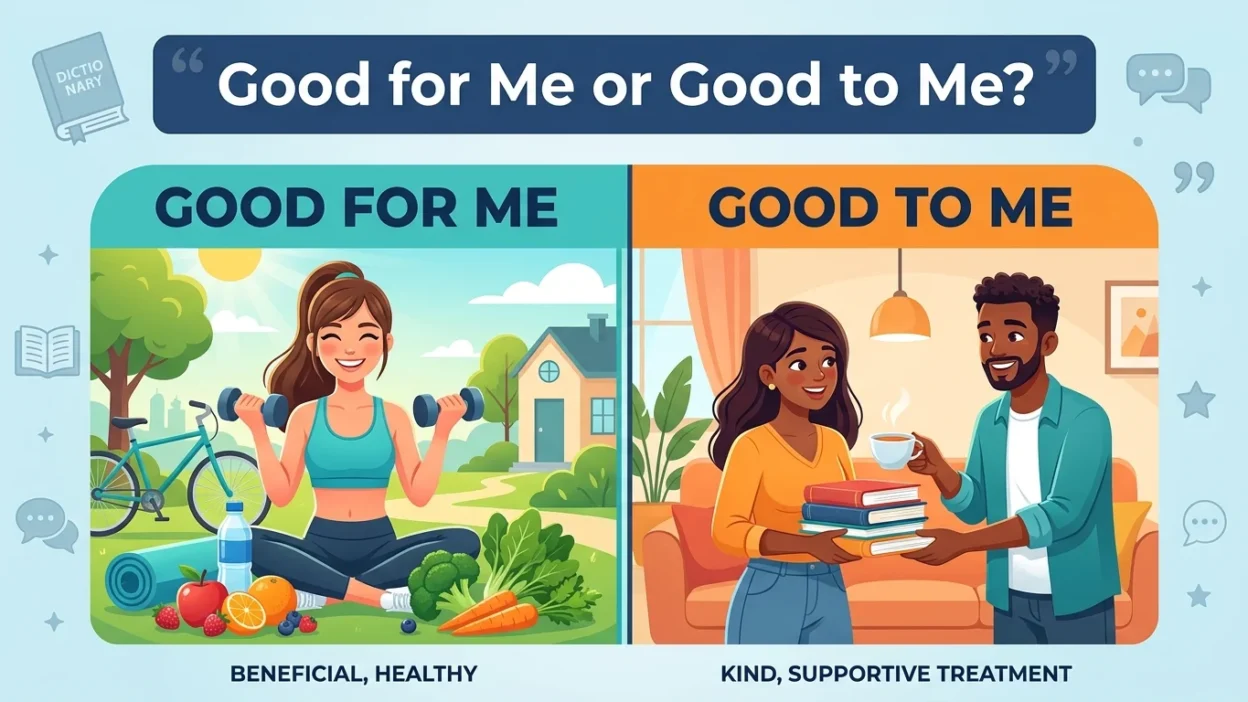
When choosing between “good for me” and “good to me,” the correct phrase depends on what you want to say. Although both expressions are grammatically correct, they describe different kinds of “good.” “Good for me” usually refers to something that benefits you, improves your health, or has a positive effect on you. “Good to me” usually describes how someone treats you or how something feels or appears to you.
For example, you might say, “Exercise is good for me” because exercise benefits your health. But you would say, “My teacher is good to me” when you mean your teacher treats you kindly. Understanding this small difference can help you sound more natural and avoid common English mistakes.
Quick Answer
“Good for me” means beneficial or helpful to me, while “good to me” usually means kind, pleasant, or favorable toward me. Say “Vegetables are good for me” when talking about benefits. Say “She is good to me” when talking about how someone treats you.
Why Do People Confuse “Good for Me” and “Good to Me”?
The confusion happens because both phrases contain good and refer to something positive.
The prepositions for and to, however, create different meanings:
- Good for me = beneficial to me
- Good to me = kind or favorable toward me
- Good for me can also describe a positive effect or result.
- Good to me often describes treatment, behavior, or an experience.
Compare these sentences:
This means walking benefits me.
This means my friends treat me kindly.
What Does “Good for Me” Mean?
“Good for me” means something is beneficial, useful, healthy, or advantageous for you.
It is commonly used when discussing:
- Health
- Habits
- Food
- Exercise
- Decisions
- Experiences
- Personal development
- Long-term benefits
Examples
- Drinking enough water is good for me.
- Reading every day is good for me.
- This decision could be good for me.
- Getting more sleep is good for me.
Here, for me shows that the thing has a positive effect on you.
What Does “Good to Me” Mean?
“Good to me” usually means someone treats you well, kindly, or fairly.
It can also mean something seems pleasant or favorable from your perspective.
Examples
- My parents have always been good to me.
- She has been very good to me.
- My boss is good to me.
- You have always been good to me.
In these examples, to me focuses on treatment or behavior toward the speaker.
Good for Me vs. Good to Me: Comparison Table
| Phrase | Main Meaning | Common Use | Example |
|---|---|---|---|
| Good for me | Beneficial or helpful | Health, habits, choices, effects | Exercise is good for me. |
| Good to me | Kind or favorable toward me | People, treatment, relationships | My friend is good to me. |
| Good for you | Beneficial for you | Health or personal benefit | Fresh fruit is good for you. |
| Good to you | Kind toward you | Treatment or behavior | She has always been good to you. |
When Should You Use “Good for Me”?
Use “good for me” when something provides a benefit or has a positive effect.
The experience helped or benefited the speaker.
When Should You Use “Good to Me”?
Use “good to me” when describing how another person behaves toward you.
The focus is on how someone treats the speaker.
10+ Examples of “Good for Me” and “Good to Me”
- Running is good for me.
Running benefits my health. - My doctor says more sleep is good for me.
More sleep would benefit me. - This job is good for me.
The job has positive effects or benefits for me. - Learning another language is good for me.
Learning a language benefits me. - Taking some time off was good for me.
The break had a positive effect on me. - My parents are good to me.
My parents treat me kindly. - My manager is good to me.
My manager treats me well. - She has always been good to me.
She has consistently treated me kindly. - My friends are good to me.
My friends treat me well. - He was very good to me when I was struggling.
He treated me kindly during a difficult time. - This relationship is good for me.
The relationship benefits me. - He is good to me.
He treats me well.
Notice the important distinction:
Common Mistakes
Mistake 1: Using “Good to Me” for Health Benefits
❌ Exercise is good to me.
✅ Exercise is good for me.
When discussing health or personal benefits, use for.
Mistake 2: Using “Good for Me” to Describe Kind Treatment
❌ My mother is good for me because she treats me kindly.
This sentence can have a different meaning: it may suggest that having your mother in your life benefits you.
If you mean she treats you kindly, say:
✅ My mother is good to me.
Mistake 3: Forgetting That Context Can Change Meaning
Consider:
This can mean he has a positive influence on me or that being with him benefits me.
Compare:
This means he treats me well.
Both are correct, but they communicate different ideas.
Memory Trick
Remember this simple rule:
FOR = benefit
TO = treatment
If something benefits you, it is good for you.
If someone treats you kindly, they are good to you.
Think:
American vs. British English
The distinction between “good for me” and “good to me” is generally the same in American and British English.
Both varieties use:
- good for me for benefits or positive effects
- good to me for kind or favorable treatment
For example:
These constructions are natural in both American and British English.
Similar Words and Expressions
Several related expressions can help you understand the difference.
Good for
Means beneficial or advantageous.
Good to
Often means kind or favorable toward someone.
Beneficial to
Means having a positive effect.
Kind to
Means treating someone with kindness.
Helpful to
Means providing assistance or benefit.
Healthy for
Means beneficial to physical or mental well-being.
Final Verdict
Both “good for me” and “good to me” are correct, but they are not interchangeable in every situation.
Use “good for me” when you mean beneficial, healthy, helpful, or advantageous to me.
Use “good to me” when you mean kind, caring, or favorable toward me.
The easiest rule is:
Good for me = benefit.
Good to me = treatment.
FAQs:
Is “good for me” grammatically correct?
Yes. “Good for me” is grammatically correct and usually means that something benefits you or has a positive effect on you.
Is “good to me” grammatically correct?
Yes. “Good to me” is also correct. It commonly describes someone who treats you kindly or well.
Should I say “exercise is good for me” or “exercise is good to me”?
Say “Exercise is good for me.” Exercise provides health and physical benefits, so for is the natural preposition.
Should I say “he is good for me” or “he is good to me”?
Both can be correct, but the meaning changes. “He is good for me” means he has a beneficial influence on you. “He is good to me” means he treats you well.
What is the difference between “good for you” and “good to you”?
“Good for you” means beneficial to you. “Good to you” means kind or favorable toward you.
Can “good for me” describe a person?
Yes. For example, “She is good for me” can mean that her influence, companionship, or relationship benefits you.
Can “good to me” describe food?
Usually, “good for me” is more natural when talking about food’s health benefits. For example, “Vegetables are good for me.”
Remember This
- Good for me = beneficial to me.
- Good to me = kind or favorable toward me.
- Use for when you mean benefit.
- Use to when you mean treatment.
- Exercise is good for me.
- My friends are good to me.
Understanding the difference between “good for me” and “good to me” is mainly about understanding the prepositions for and to. Although both expressions describe something positive, they focus on different relationships.
Use “good for me” when you are talking about benefits, health, personal growth, or positive effects. Use “good to me” when you are talking about kindness, behavior, or the way another person treats you. Once you connect for with benefit and to with treatment, the difference becomes much easier to remember.

Levi Jack is a creative writer and conversation expert passionate about helping people communicate confidently. At ReplyCorner, he shares charming, witty, and engaging reply ideas that make everyday conversations more enjoyable and memorable.