When you want to describe a place where customers can order food or other services without leaving their cars, you may wonder if the correct spelling is drive thru or drive through. Both forms are used in English, but they do not have exactly the same status or style.
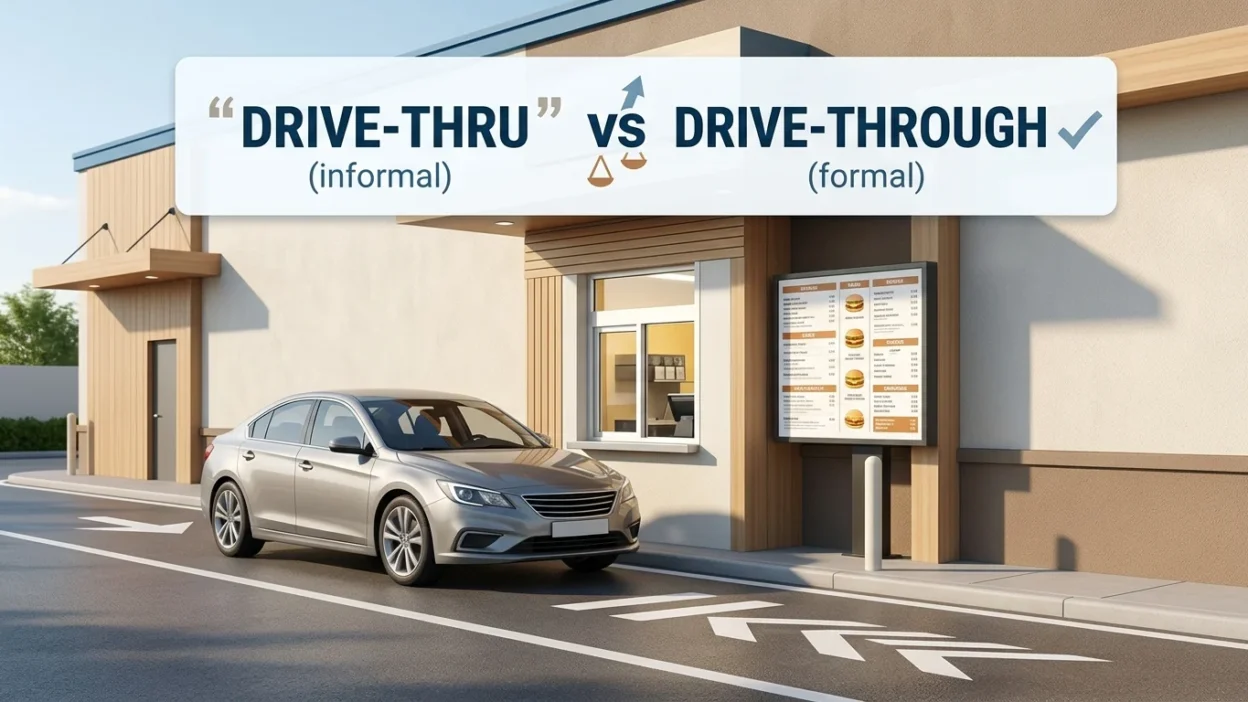
Drive-through is the standard spelling in formal writing and is widely used in American English. Drive-thru is a shorter, informal spelling commonly seen on signs, menus, business names, and advertising. The two forms usually refer to the same thing. This guide explains when to use each spelling, how they differ, and which one is better for formal and casual writing.
Quick Answer
Drive-through is the standard spelling, while drive-thru is a common informal variant. Use drive-through in formal writing, and use drive-thru for signs, menus, advertisements, and casual contexts. Both describe a service where customers remain in their vehicles.
Why Do People Confuse “Drive Thru” and “Drive Through”?
The confusion comes from the fact that through and thru sound the same but have different levels of formality.
Through is the standard English spelling. Thru is a shortened spelling that is especially common in American commercial language.
You may see:
- drive-through restaurant
- drive-thru restaurant
- drive-through window
- drive-thru window
- drive-through service
- drive-thru service
In most cases, the meaning is unchanged.
Is “Drive Thru” Correct?
Drive-thru is correct as an informal and commercial spelling.
It is particularly common on:
- Restaurant signs
- Menus
- Advertisements
- Store names
- Road signs
- Business websites
- Casual writing
For example:
The spelling drive-thru is widely recognized and natural in everyday American English.
Is “Drive Through” Correct?
Yes. Drive-through is the standard form when the expression is used as a compound noun or adjective.
For example:
When used as a verb phrase, however, drive through can have a different meaning:
Here, through is part of the verb phrase and does not refer to a drive-through service.
Drive Thru vs Drive Through: Comparison Table
| Feature | Drive-thru | Drive-through |
|---|---|---|
| Meaning | Vehicle-based service | Vehicle-based service |
| Standard spelling | Informal variant | Standard form |
| Common in signs | Yes | Yes |
| Common in advertising | Very common | Common |
| Formal writing | Less preferred | Preferred |
| American English | Very common | Very common |
| British English | Less common | More standard |
| Meaning as a verb | Can be used informally | Can also form the verb phrase “drive through” |
When Should You Use “Drive-thru”?
Use drive-thru when you want a short, familiar, and informal style.
It works especially well in commercial contexts.
Signs
Menu
Advertising
Casual messages
The shorter spelling can make business language feel more direct and approachable.
When Should You Use “Drive-through”?
Use drive-through when you want the more standard spelling, especially in formal or edited writing.
For example:
It is also a good choice for school assignments, reports, professional documents, and other contexts where standard spelling is preferred.
Drive Thru or Drive Through: 12 Examples
Here are some natural examples showing how both forms are used.
- The restaurant has a drive-through window.
- We ordered our lunch at the drive-thru.
- The drive-through is open until midnight.
- Let’s stop at the drive-thru before going home.
- The new café offers drive-through service.
- The drive-thru line was very long this morning.
- Customers can pick up their orders through the drive-through window.
- I usually use the drive-thru when I’m in a hurry.
- The restaurant has separate entrances for dine-in and drive-through customers.
- There’s a drive-thru coffee shop near my office.
- The drive-through lane is closed for maintenance.
- She bought breakfast at the drive-thru.
Notice that drive-thru and drive-through can usually be substituted when they function as the same noun or adjective.
Common Mistakes
1. Treating “thru” as the only correct spelling
Thru is widely used, but it is an informal spelling.
For formal writing, through is generally the safer choice.
2. Writing “drive thru” in every context
When the words function together as a compound adjective or noun, drive-thru or drive-through is often written with a hyphen.
3. Confusing “drive-through” with “drive through”
These can have different grammatical functions.
The hyphen can help distinguish the compound expression from the ordinary verb phrase.
4. Assuming “thru” is appropriate in formal writing
Although thru is common and easily understood, through is usually the better choice when writing formally.
Memory Trick
Think of it this way:
Drive-through = standard spelling
Drive-thru = shortened, informal spelling
A simple rule is:
American vs British English
The expression is strongly associated with American English, particularly because of the widespread use of drive-through restaurants and services in the United States.
Drive-through is the more conventional full spelling and can be understood internationally.
Drive-thru is especially common in American commercial language, where shortened spellings are frequently used for signs and branding.
British English also uses drive-through, although the concept and terminology may be less prominent in everyday British usage than in American English.
Similar Words
Several related expressions can describe similar services or situations:
- Drive-through — a service accessed while remaining in a vehicle.
- Drive-thru — an informal spelling of drive-through.
- Drive-in — a place where customers can drive their vehicles into or near a service area.
- Pick-up window — a window where customers collect an order.
- Takeaway — food purchased to eat elsewhere, especially common in British English.
- Takeout — food purchased to eat elsewhere, especially common in American English.
These terms are related but are not always interchangeable.
Final Verdict
Drive-through is the standard spelling and the better choice for formal writing.
Drive-thru is a widely accepted informal variant that is especially common on signs, menus, advertisements, and in casual American English.
If you are unsure which one to choose, use drive-through. If you are writing a restaurant sign or casual advertisement, drive-thru is perfectly natural.
FAQs:
Is “drive thru” or “drive through” correct?
Both are used to describe vehicle-based service. Drive-through is the standard spelling, while drive-thru is a common informal variant.
Is “drive-thru” one word?
Drive-thru is normally written as a hyphenated compound. It is a shortened form of drive-through.
Should I write “drive thru” or “drive-thru”?
Drive-thru is preferable when using the shortened form because the hyphen shows that the two words function together as a compound.
Is “drive-through” formal?
Yes. Drive-through is the standard form and is suitable for formal, professional, and academic contexts.
Is “drive-thru” American English?
It is particularly common in American English, especially in restaurant signs, advertising, menus, and casual writing.
Is “drive through” two words?
It can be. When drive through is a verb phrase, it is written as two words:
When referring to the service, drive-through is normally hyphenated.
What is the difference between drive-in and drive-through?
A drive-in generally allows customers to drive into or park at a designated area for service. A drive-through lets customers order or receive a service without leaving their vehicles.
Remember This
Drive-through = standard spelling
Drive-thru = informal shortened spelling
Drive through = verb phrase when describing movement
For formal writing, choose drive-through. For signs, menus, and casual commercial language, drive-thru is common and natural.
Conclusion
The choice between drive thru or drive through mainly depends on spelling style and context rather than meaning. Drive-through is the standard form and is the safest choice when you want polished, formal English. Drive-thru is a shorter, widely used variant that works especially well in signs, menus, advertising, and everyday conversation.
Remember that drive-through describes a vehicle-based service, while drive through can simply describe the action of traveling through a place. Understanding this small distinction will help you choose the right form naturally and confidently.

David Owen is a passionate writer and communication enthusiast dedicated to helping readers craft charming, witty, and thoughtful replies. Through ReplyCorner, he shares creative response ideas that make conversations engaging and memorable.