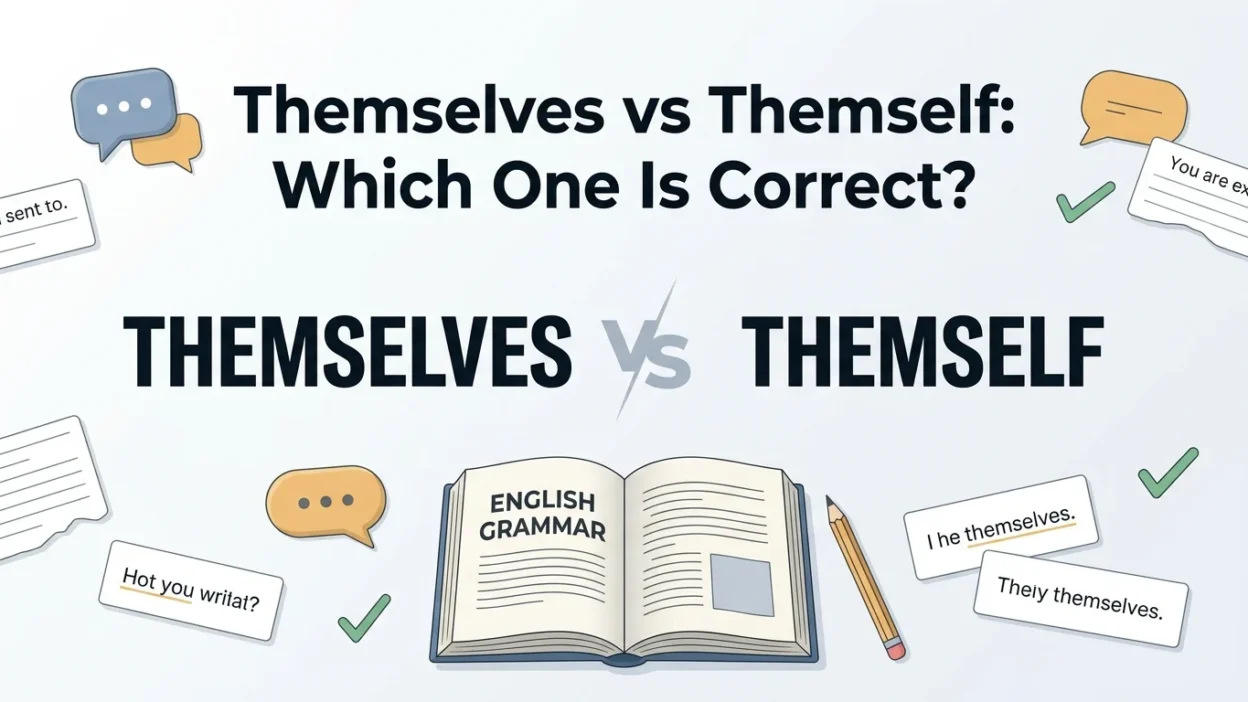
When deciding between themselves vs themself, the correct choice depends mainly on if they refers to more than one person or to one person. Themselves is the traditional and widely accepted reflexive pronoun for plural they and is also commonly used with singular they. Themself is a singular reflexive form that can be used when they clearly refers to one person. Both forms exist, but themselves is more widely established and generally safer in formal writing.
Understanding the difference can make your English sound more natural and precise. The confusion often comes from the increasing use of singular they, which refers to one person whose gender is unknown, unspecified, or nonbinary. In those situations, writers may wonder if to use themselves or themself. This guide explains the difference with simple rules, examples, and practical situations.
Quick Answer
Themselves is the standard reflexive pronoun for plural they and is also widely used with singular they. Themself is a singular reflexive form used when they refers to one person. In formal writing, themselves is usually the more established choice, while themself can provide clearer singular agreement.
Why Do People Confuse Them?
The confusion comes from the fact that they can be either plural or singular.
For example:
- The students prepared themselves.
Here, they refers to several students. - Someone should ask themselves if this is necessary.
Here, they refers to one unspecified person.
Once they became widely used as a singular pronoun, speakers and writers began using both themselves and themself as reflexive forms.
The traditional form themselves remains very common. Themself, however, is used when the writer wants the reflexive pronoun to clearly indicate one person.
What Does “Themselves” Mean?
Themselves is a reflexive pronoun used when the subject and object refer to the same people.
It is normally associated with plural they.
Examples
- The children dressed themselves.
- The employees introduced themselves.
- They blamed themselves for the mistake.
- The players congratulated themselves after the game.
In these sentences, more than one person is involved.
Themselves can also follow singular they:
Here, they refers to one unspecified person, but themselves is still commonly used.
What Does “Themself” Mean?
Themself is a singular reflexive pronoun associated with singular they.
It is particularly useful when they clearly refers to one person.
Examples
- Jordan reminded themself to call the doctor.
- Each person should ask themself if the decision is fair.
- The applicant should introduce themself.
- Someone needs to take responsibility for themself.
The word themself is recognized in modern English, although it is less established and less widely used than themselves.
It can be especially helpful when the writer wants to make singular reference completely clear.
Themselves vs Themself: Comparison Table
| Feature | Themselves | Themself |
|---|---|---|
| Main use | Plural they | Singular they |
| Refers to several people | Yes | No |
| Refers to one person | Yes, commonly | Yes |
| Traditional usage | Very well established | Less traditional |
| Formal writing | Widely accepted | Acceptable in appropriate contexts |
| Singular they | Commonly used | Specifically emphasizes singular reference |
| Example | They introduced themselves. | Alex reminded themself. |
When Should You Use “Themselves”?
Use themselves when they refers to multiple people.
Example
The subject refers to several teachers, so themselves is appropriate.
You can also use themselves with singular they, especially when the person’s identity is unknown or unspecified.
Example
This is natural and widely understood.
When Should You Use “Themself”?
Use themself when they clearly refers to one individual and you want the reflexive form to show singular reference.
Example
Taylor is one person, so themself makes the singular reference explicit.
It can also be useful with words such as each, everyone, someone, and anyone when the intended referent is one individual.
Example
However, themselves is also widely used in such constructions:
Both forms can be encountered in modern English, but themselves remains much more familiar.
Themselves vs Themself: 10+ Examples
1. Plural people
Use themselves because children is plural.
2. Several employees
Use themselves because there is more than one employee.
3. One unspecified person
Themselves is commonly used with singular they.
4. One specific person
Themself emphasizes that they refers to one person.
5. A group making a decision
The members are plural, so themselves is correct.
6. An individual reflecting
Riley is one person, so themself can be used.
7. General advice
This traditional form is extremely common.
8. Emphasizing one individual
Here, themself emphasizes the singular meaning of each applicant.
9. A group acting independently
Themselves refers to several students.
10. Singular they in everyday English
Themselves is natural here.
11. One person using singular they
Themself clearly signals that Morgan is one person.
12. Multiple people
Use themselves because friends is plural.
Common Mistakes
Mistake 1: Using “themself” for a group
Incorrect:
The students prepared themself for the exam.
Better:
Because students is plural, use themselves.
Mistake 2: Assuming “themselves” can never refer to one person
Some learners believe that themselves must always refer to several people.
Modern English commonly uses themselves with singular they:
So the form is not automatically wrong simply because they refers to one person.
Mistake 3: Choosing “themself” whenever the subject is singular
A singular noun does not automatically require themself.
For example:
Everyone should look after themselves.
This construction is common and grammatically established.
Mistake 4: Forgetting the difference between “them” and “themselves”
Them is an object pronoun.
Themselves and themself are reflexive forms.
Memory Trick
Use this simple rule:
Several people → themselves
One person using singular they → themself can be used
But remember that themselves is also commonly used with singular they:
So think of themself as the form that makes the singular meaning more explicit, rather than as a replacement that makes themselves incorrect.
American vs British English
The basic distinction is broadly understandable in both American and British English.
Themselves is well established in both varieties and is widely used with plural they. It is also common with singular they.
Themself appears in both varieties as a singular reflexive form, particularly in contexts involving singular they. Its use is less widespread and may sound less familiar to some readers.
Therefore, regional English does not create a simple rule such as “Americans use one form and British speakers use the other.” Context and style matter more.
Similar Words
Understanding related pronouns can make the distinction easier.
- They — subject pronoun
They arrived early. - Them — object pronoun
I called them. - Their — possessive determiner
Their car is outside. - Theirs — possessive pronoun
The car is theirs. - Themselves — reflexive pronoun, usually plural and also common with singular they
They introduced themselves. - Themself — singular reflexive form of they
Alex introduced themself.
Final Verdict
Themselves is the standard and more widely established choice, especially when they refers to multiple people. It is also commonly used when they refers to one person.
Themself is a recognized singular reflexive form and can be useful when singular they refers clearly to one individual.
So:
If you are writing for a formal or broad audience and there is no reason to emphasize singular agreement, themselves will usually be the more familiar choice.
FAQs:
Is “themself” grammatically correct?
Yes. Themself is used as a singular reflexive form of they, particularly when they clearly refers to one person. It is less established than themselves, but it is a recognized form in modern English.
Is “themselves” singular or plural?
Traditionally, themselves is the plural reflexive form of they. However, it is also widely used with singular they, so it can refer to one person in modern English.
Should I say “themselves” or “themself”?
Use themselves for plural they. When they refers to one person, themself can be used to make the singular meaning explicit, while themselves is also common.
Is “themself” more correct than “themselves” for one person?
Not necessarily. Themself specifically reflects singular reference, but themselves is also widely accepted and used with singular they. The appropriate choice can depend on context, audience, and style.
Can “themself” refer to multiple people?
Generally, no. Themself is used for singular reference. For multiple people, use themselves.
Is “themselves” correct with “someone”?
Yes.
This is a common construction using singular they with themselves.
Which is better in formal writing: “themselves” or “themself”?
Themselves is generally the more familiar and established choice. However, themself can be appropriate when referring clearly to one individual with singular they and when the chosen style accepts the form.
Remember This
- Themselves = standard plural reflexive form and widely used with singular they.
- Themself = singular reflexive form of they.
- Use themselves for a group.
- Use themself when you want to clearly emphasize that singular they refers to one person.
- Themselves can also be correct for a single person using singular they.
Conclusion
The difference between themselves vs themself mainly comes down to number and context. Themselves is the familiar, established reflexive form for plural they and is also widely used with singular they. Themself provides a specifically singular alternative when they refers to one individual.
For everyday and formal writing, context should guide your choice. If several people are involved, choose themselves. If one person is being referred to with singular they, themself can make that singular meaning especially clear, while themselves remains a common option.