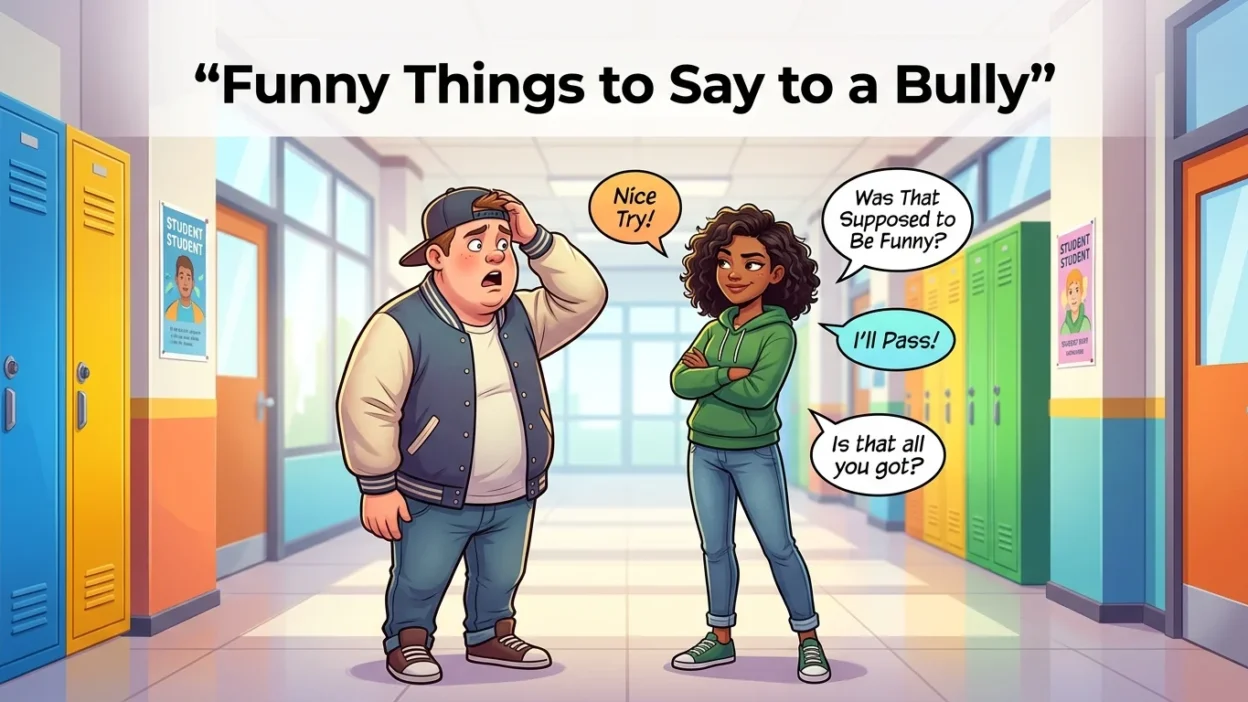
Dealing with a bully can be frustrating, embarrassing, or exhausting, especially when they are trying to get a reaction from you. Sometimes, a lighthearted and clever response can help you stay confident without turning the situation into a bigger argument. The best funny things to say to a bully are usually short, calm, and witty rather than cruel or threatening.
If you need a clever comeback for school, work, social media, or everyday situations, humor can help you show that their words do not control you. These funny bully comebacks are designed to be playful, confident, and easy to remember while still keeping healthy boundaries. If bullying becomes threatening, repeated, or unsafe, it is better to involve a trusted person or authority rather than relying on a comeback.
1. “Did You Practice That One?”
A bully may expect you to look upset. Asking whether they practiced their insult can turn the moment into something unexpectedly funny.
Best for: A rehearsed or predictable insult.
Alternative: “Was that your best one?”
Examples:
“Did you practice that one in the mirror?”
“Was that comeback rehearsed or naturally awkward?”
2. “Thanks for the Free Entertainment.”
This playful response suggests that the bully is amusing rather than intimidating.
Best for: Someone trying hard to annoy you.
Alternative: “At least you’re keeping things interesting.”
Examples:
“Thanks for the free entertainment.”
“Wow, this conversation came with comedy included.”
3. “You Seem Very Invested in Me.”
Sometimes simply pointing out how much attention the bully is giving you can make their behavior look silly.
Best for: Someone constantly commenting on you.
Alternative: “You really keep up with my life, huh?”
Examples:
“You seem very invested in me.”
“Wow, you know a surprising amount about what I’m doing.”
4. “Is That All You’ve Got?”
A confident question can show that the insult has not affected you.
Best for: Mild teasing or repetitive insults.
Alternative: “That was your big moment?”
Examples:
“Is that all you’ve got?”
“I was expecting a little more creativity.”
5. “Interesting Opinion. I’ll File It Under ‘Not Important.’”
This comeback creates a humorous way to dismiss an unwanted opinion.
Best for: Unsolicited criticism.
Alternative: “Thanks, but I’ll pass on that opinion.”
Examples:
“Interesting opinion. I’ll file it under ‘not important.’”
“Thanks for sharing. I’ll probably never use that information.”
6. “You Must Be Having a Boring Day.”
A funny response can suggest that the bully is picking on you simply because they have nothing better to do.
Best for: Someone repeatedly trying to get your attention.
Alternative: “Need a hobby?”
Examples:
“You must be having a very boring day.”
“Is bothering me your main activity today?”
7. “That Was Almost Funny.”
This playful comeback takes some power away from an attempted joke.
Best for: A weak insult disguised as humor.
Alternative: “Nice attempt.”
Examples:
“That was almost funny.”
“Give it another try; you were getting close.”
8. “I’ll Pretend That Was a Compliment.”
Turning an insult into a joke can show that you are not taking the bait.
Best for: Personal comments that are meant to embarrass you.
Alternative: “I’m choosing to take that positively.”
Examples:
“I’ll pretend that was a compliment.”
“Thanks—I’m sure that sounded better in your head.”
9. “You’re Trying Very Hard.”
Sometimes the simplest observation can be the funniest.
Best for: Someone obviously trying to provoke you.
Alternative: “You’re putting a lot of effort into this.”
Examples:
“You’re trying very hard, and I respect the dedication.”
“That’s a lot of effort for such a small reaction.”
10. “Congratulations, You Got My Attention.”
This line humorously acknowledges the bully without giving them the emotional reaction they want.
Best for: Attention-seeking behavior.
Alternative: “Okay, I heard you.”
Examples:
“Congratulations, you got my attention.”
“Achievement unlocked: you got a response.”
11. “I’d Respond, but I Left My Patience at Home.”
This is a light way to signal that you are not interested in arguing.
Best for: A conversation that is becoming annoying.
Alternative: “I’m fresh out of patience today.”
Examples:
“I’d respond, but I left my patience at home.”
“Sorry, my patience is currently unavailable.”
12. “That’s a Lot of Confidence for Such a Weak Joke.”
This comeback combines humor with confidence without resorting to threats.
Best for: A bully making a poor joke at your expense.
Alternative: “Bold delivery for a questionable joke.”
Examples:
“That’s a lot of confidence for such a weak joke.”
“You really delivered that like it was a masterpiece.”
13. “Should I Laugh Now or Later?”
A playful question can make a weak insult lose its impact.
Best for: Someone expecting you to laugh at their insult.
Alternative: “Was there supposed to be a punchline?”
Examples:
“Should I laugh now or later?”
“Wait, was that the joke?”
14. “I’m Not Taking Requests Today.”
This response creates a humorous boundary when someone keeps demanding your attention.
Best for: Persistent teasing or unwanted comments.
Alternative: “The customer service desk is closed.”
Examples:
“I’m not taking requests today.”
“Sorry, my attention department is closed.”
15. “You’ve Got a Lot to Say for Someone I’m Not Listening To.”
This is a confident way to disengage from unnecessary comments.
Best for: Repeated verbal provocation.
Alternative: “You can keep talking; I’m still not interested.”
Examples:
“You’ve got a lot to say for someone I’m not listening to.”
“That’s quite a speech, but I’m not attending.”
16. “Thanks for Your Concern, Doctor.”
This sarcastic line works when someone is unnecessarily analyzing your appearance, choices, or behavior.
Best for: Unwanted personal commentary.
Alternative: “Thanks for the expert diagnosis.”
Examples:
“Thanks for your concern, Doctor.”
“I didn’t realize I had an appointment today.”
17. “I’ll Add That to My List of Things I Don’t Care About.”
This humorous dismissal can help you avoid getting pulled into an argument.
Best for: Opinions that are clearly meant to upset you.
Alternative: “That’s going straight into my ‘ignore’ folder.”
Examples:
“I’ll add that to my list of things I don’t care about.”
“Perfect, another entry for my very long ignore list.”
18. “You’re Really Committed to This Bit.”
Calling bullying a “bit” can make the behavior seem less serious without escalating the situation.
Best for: Someone repeatedly making the same joke.
Alternative: “You’re really sticking with that routine.”
Examples:
“You’re really committed to this bit.”
“Honestly, your dedication to the same joke is impressive.”
19. “I’m Going to Let You Enjoy Your Moment.”
This response communicates that you are not interested in continuing the interaction.
Best for: Ending an unnecessary confrontation.
Alternative: “Enjoy your moment; I’m moving on.”
Examples:
“I’m going to let you enjoy your moment.”
“Go ahead and have your moment. I’ve got places to be.”
20. “That Sounded Better in Your Head, Didn’t It?”
This witty comeback points out when an insult fails to land.
Best for: An awkward or poorly delivered insult.
Alternative: “I think that sounded funnier in your imagination.”
Examples:
“That sounded better in your head, didn’t it?”
“I’m guessing the rehearsal went better than the live version.”
21. “Wow, You Really Woke Up and Chose Nonsense.”
This modern phrase adds humor without needing a harsh insult.
Best for: Random or ridiculous comments.
Alternative: “Someone woke up feeling dramatic.”
Examples:
“Wow, you really woke up and chose nonsense.”
“Looks like drama is on today’s schedule.”
22. “I’ll Give That Comeback a Participation Trophy.”
This playful line suggests that the insult deserves credit for trying, but not much else.
Best for: A weak comeback.
Alternative: “Nice effort. Gold star for trying.”
Examples:
“I’ll give that comeback a participation trophy.”
“Nice effort—you definitely participated.”
23. “Please Continue. I’m Collecting Bad Opinions.”
This turns the bully’s comments into a joke about their lack of usefulness.
Best for: Someone giving multiple unwanted opinions.
Alternative: “Keep going; my collection is growing.”
Examples:
“Please continue. I’m collecting bad opinions.”
“Go ahead—I’m building quite the collection today.”
24. “My Day Was Going Fine Until This Plot Twist.”
This response uses humor to show that you are unimpressed rather than intimidated.
Best for: Unexpected teasing.
Alternative: “Well, this wasn’t on today’s schedule.”
Examples:
“My day was going fine until this plot twist.”
“Interesting. This definitely wasn’t on my agenda.”
25. “You’re Free to Have That Opinion.”
Sometimes a calm response is more powerful than a clever insult.
Best for: Handling criticism maturely.
Alternative: “You’re entitled to your opinion.”
Examples:
“You’re free to have that opinion. I’m free to ignore it.”
“That’s your opinion, and I don’t have to agree with it.”
26. “I’m Not Competing in the Drama Olympics.”
This funny phrase is useful when someone tries to turn a small issue into a major argument.
Best for: Dramatic confrontations.
Alternative: “I’m not signing up for this drama.”
Examples:
“I’m not competing in the Drama Olympics today.”
“Sorry, I didn’t train for this level of drama.”
27. “You Can Keep the Spotlight.”
This response makes it clear that you do not want attention from the situation.
Best for: Someone trying to perform in front of others.
Alternative: “The stage is yours.”
Examples:
“You can keep the spotlight. I’m good.”
“The stage is yours; I’m stepping out of the show.”
28. “I’m Going to Choose Peace Over This Conversation.”
A funny comeback does not always need to be sarcastic. Sometimes confidence means walking away.
Best for: Situations that could become heated.
Alternative: “I’m not wasting my energy on this.”
Examples:
“I’m choosing peace over this conversation.”
“I could argue, but peace sounds much better.”
29. “That’s Enough Free Attention for One Day.”
This line humorously establishes a boundary and signals that the conversation is finished.
Best for: Someone repeatedly trying to provoke you.
Alternative: “Your attention budget has expired.”
Examples:
“That’s enough free attention for one day.”
“Sorry, your free trial of my attention has ended.”
30. “Anyway, I’ve Got Better Things to Do.”
Sometimes the best comeback is simply refusing to participate.
Best for: Ending a bullying interaction calmly.
Alternative: “I’m moving on.”
Examples:
“Anyway, I’ve got better things to do.”
“Enjoy the conversation with yourself—I’m moving on.”
FAQs:
1. What are the best funny things to say to a bully?
The best responses are short, calm, and confident. Lines such as “Did you practice that one?” or “You seem very invested in me” can add humor without encouraging a bigger confrontation.
2. Should I make fun of the bully back?
Usually, it is better to avoid personal attacks. A clever response that focuses on the situation rather than the person’s appearance, family, identity, or vulnerabilities is less likely to escalate the conflict.
3. What if the bully keeps bothering me?
If someone continues bullying you after you have clearly disengaged, do not feel pressured to keep coming up with comebacks. Walk away when possible and tell a trusted adult, teacher, supervisor, parent, or another appropriate person.
4. Can funny comebacks stop bullying?
Sometimes humor can discourage a person who is simply looking for a reaction, but it is not a guaranteed solution. Persistent, threatening, or physical bullying should be handled with support from trusted people and appropriate authorities.
5. What is the safest comeback to a bully?
A calm statement such as “I’m not interested in this conversation” is often one of the safest choices. You do not have to win an argument to protect your confidence or set a boundary.
Conclusion
Funny things to say to a bully can help you respond with confidence when you want to avoid giving someone the reaction they are looking for. The strongest comebacks are usually clever rather than cruel, short rather than argumentative, and confident rather than aggressive.
Remember, you do not owe a bully a perfect comeback. If a situation feels unsafe, threatening, or persistent, prioritize your safety and seek help from someone you trust. Sometimes the most powerful response is simply walking away, refusing to engage, and letting the right people handle the behavior.

Levi Jack is a creative writer and conversation expert passionate about helping people communicate confidently. At ReplyCorner, he shares charming, witty, and engaging reply ideas that make everyday conversations more enjoyable and memorable.