
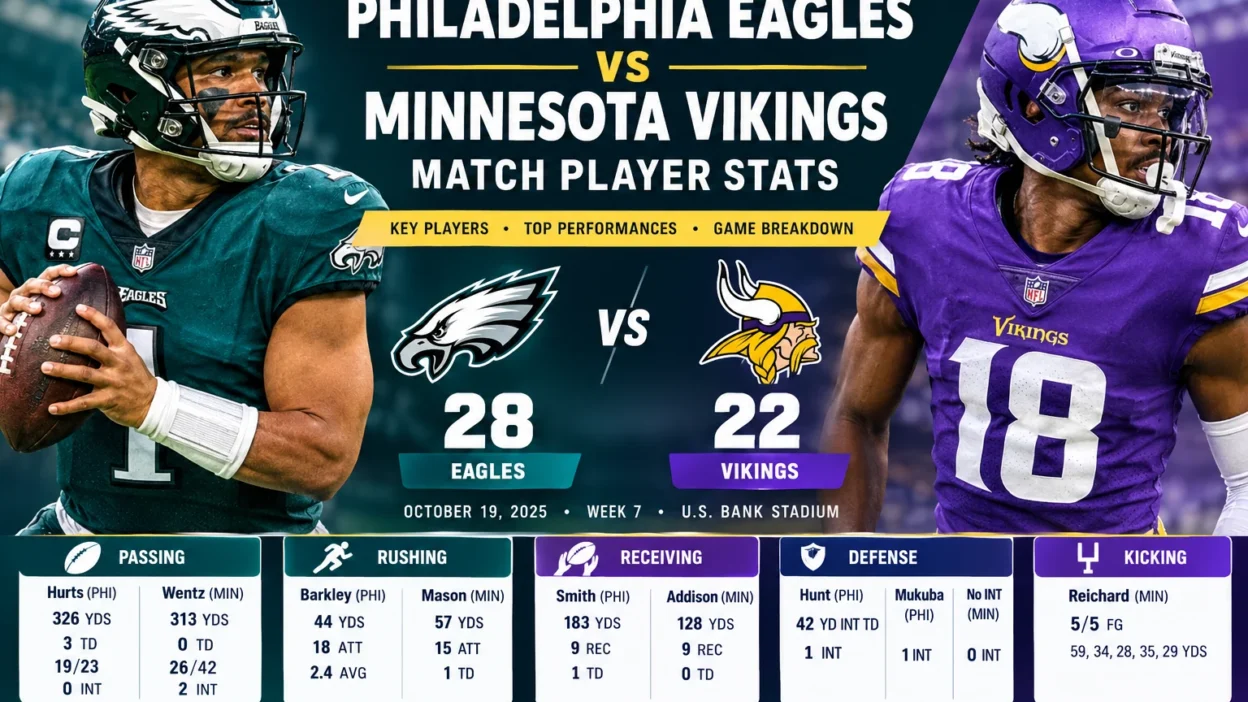
The Philadelphia Eagles vs Minnesota Vikings match player stats help fans understand how both teams perform in a head-to-head NFL matchup. These statistics can include passing yards, rushing attempts, receiving yards, touchdowns, tackles, sacks, interceptions, and other important contributions. They show which players made the biggest impact and how individual performances influenced the game.
If you support the Eagles or the Vikings, reviewing player statistics gives you a clearer picture of the contest. Quarterback accuracy, running-back production, receiver efficiency, and defensive pressure can all affect the final result. However, the exact numbers depend on the specific game being analyzed. A regular-season meeting and a previous-season matchup may have completely different statistics, scores, and standout players.
This guide explains how to read the Philadelphia Eagles vs Minnesota Vikings player stats, compare performances, understand important football terms, and identify the numbers that matter most. It also provides examples to help beginners understand common NFL box-score statistics without getting lost in technical language.
Quick Answer
Philadelphia Eagles vs Minnesota Vikings match player stats include passing, rushing, receiving, and defensive numbers for both teams. The most useful figures are passing yards, rushing yards, receptions, touchdowns, sacks, and turnovers. To provide accurate player-by-player statistics, you need to identify the specific game by its date or season.
Philadelphia Eagles vs Minnesota Vikings: Match Overview
The Philadelphia Eagles defeated the Minnesota Vikings 28–22 on October 19, 2025, at U.S. Bank Stadium in Minneapolis. The Week 7 regular-season game featured three passing touchdowns from Jalen Hurts and an important interception-return touchdown by Eagles defender Jalyx Hunt.
pro-football-reference.com
+1
Philadelphia Eagles
Away team
28
Minnesota Vikings
Home team
22
October 19, 2025 · Week 7 · U.S. Bank Stadium
Source:
Official NFL game center
What decided the game?
- Passing: Philadelphia’s Jalen Hurts threw three touchdown passes and no interceptions.
- Receiving: DeVonta Smith recorded 183 receiving yards, while A.J. Brown scored two receiving touchdowns.
- Defense: Jalyx Hunt returned an interception 42 yards for an Eagles touchdown.
- Minnesota’s response: The Vikings gained more total yards and controlled the ball longer, but two interceptions hurt their chances of winning.
pro-football-reference.com+2
First Word: Philadelphia Eagles Player Stats
The Eagles’ offensive performance was led by quarterback Jalen Hurts and wide receivers DeVonta Smith and A.J. Brown. Their passing connection produced three touchdowns and several big plays.
Jalen Hurts — Quarterback Stats
Jalen Hurts
Quarterback · Philadelphia Eagles
326
Passing yards
3
Passing TDs
19/23
Completions
0
Interceptions
Hurts completed 19 of 23 passes for 326 yards. His three touchdown passes helped Philadelphia score consistently, and he avoided throwing an interception. He also rushed four times for minus 10 yards.
pro-football-reference.com
+1
DeVonta Smith — Receiving Stats
DeVonta Smith
Wide receiver
183
Receiving yards
9
Receptions
Smith caught nine passes on 11 targets for 183 yards and one touchdown. His longest reception covered 79 yards, making him Philadelphia’s leading receiver by yardage in this matchup.

NFL
+1
A.J. Brown — Receiving Stats
A.J. Brown
Wide receiver
121
Receiving yards
2
Receiving TDs
4
Receptions
6
Targets
Brown caught four passes for 121 yards and two touchdowns. His scoring receptions came on plays of 37 and 26 yards. His ability to turn a small number of catches into major scoring plays was central to Philadelphia’s victory.
pro-football-reference.com
+1
Saquon Barkley — Rushing Stats
Saquon Barkley
Running back
44
Rushing yards
18
Rushing attempts
Barkley carried the ball 18 times for 44 yards, averaging 2.4 yards per attempt. Although his rushing output was limited, the Eagles’ passing attack provided the explosive plays that helped secure the win.
pro-football-reference.com
+1
Other Eagles Player Stats
| Player | Category | Key performance |
|---|---|---|
| Dallas Goedert | Receiving | 3 catches, 18 yards |
| Will Shipley | Receiving | 1 catch, 7 yards |
| Tank Bigsby | Rushing | 1 carry, 11 yards |
| Jalyx Hunt | Defense | 42-yard interception return TD |
| Andrew Mukuba | Defense | 1 interception |
These figures show that the Eagles received contributions from several players beyond their leading offensive stars. Hunt’s defensive touchdown was particularly valuable because it added points without requiring an offensive scoring drive.
NFL
+1
Second Word: Minnesota Vikings Player Stats
Minnesota produced substantial passing yardage and gained more total yards than Philadelphia. However, the Vikings struggled to convert enough of those opportunities into touchdowns.
Carson Wentz — Quarterback Stats
Carson Wentz
Quarterback · Minnesota Vikings
313
Passing yards
26/42
Completions
0
Passing TDs
2
Interceptions
Wentz completed 26 of 42 passes for 313 yards. He did not throw a passing touchdown and was intercepted twice. His yardage kept Minnesota moving, but the turnovers made it harder to match Philadelphia’s scoring efficiency. He also rushed four times for 28 yards.
pro-football-reference.com
+1
Jordan Addison — Receiving Stats
Jordan Addison
Wide receiver
128
Receiving yards
9
Receptions
Addison caught nine passes on 12 targets for 128 yards. His longest reception was 34 yards. He was Minnesota’s leading receiver by yardage and helped the Vikings move the ball through the air.
pro-football-reference.com
+1
Justin Jefferson — Receiving Stats
Justin Jefferson
Wide receiver
79
Receiving yards
5
Receptions
Jefferson finished with five receptions for 79 yards on 10 targets. His longest catch covered 40 yards, but he did not record a receiving touchdown in this game.
pro-football-reference.com
+1
Jordan Mason — Rushing Stats
Jordan Mason
Running back
57
Rushing yards
15
Rushing attempts
1
Rushing TD
Mason carried the ball 15 times for 57 yards, averaging 3.8 yards per carry. He scored Minnesota’s rushing touchdown on a one-yard run in the third quarter.
pro-football-reference.com
+1
Other Vikings Player Stats
| Player | Category | Key performance |
|---|---|---|
| T.J. Hockenson | Receiving | 6 catches, 43 yards |
| Jalen Nailor | Receiving | 2 catches, 37 yards |
| Adam Thielen | Receiving | 1 catch, 10 yards |
| Josh Oliver | Receiving | 1 catch, 9 yards |
| Will Reichard | Kicking | 5 field goals made |
Reichard converted all five of his field-goal attempts, including kicks from 59, 34, 28, 35, and 29 yards. His accuracy kept Minnesota within reach, but the Vikings needed more offensive touchdowns to overcome Philadelphia’s lead.
FOX Sports
+1
Philadelphia Eagles vs Minnesota Vikings Player Stats Comparison Table
The table below compares key offensive performances from the October 19, 2025, matchup. Individual passing yards are shown separately from team passing totals because official team totals account for sack yardage.
pro-football-reference.com
+1
| Statistic | Philadelphia Eagles | Minnesota Vikings |
|---|---|---|
| Final score | 28 | 22 |
| Quarterback | Jalen Hurts | Carson Wentz |
| Passing yards | 326 | 313 |
| Pass completions | 19 | 26 |
| Pass attempts | 23 | 42 |
| Passing touchdowns | 3 | 0 |
| Interceptions thrown | 0 | 2 |
| Rushing yards | 45 | 89 |
| Receiving leader | DeVonta Smith | Jordan Addison |
| Leading receiver’s yards | 183 | 128 |
| Defensive interceptions | 2 | 0 |
Source: Official NFL gamebook and published box scores.
NFL
+1
Which Team Had Better Player Stats?
Philadelphia was more effective at turning offensive plays into touchdowns. Hurts completed a high percentage of his passes, and his three touchdown throws gave the Eagles a major advantage.
Minnesota recorded more total offensive yards and rushing yards, but Wentz’s two interceptions and the absence of a passing touchdown made the difference. Philadelphia also scored through its defense, giving it another advantage on the scoreboard.
pro-football-reference.com
+1
When to Use Each Player Statistic
Different NFL statistics answer different questions. Choose the numbers that match what you want to understand about the game.
Passing Stats
Use passing statistics to evaluate quarterbacks.
- Completions: How many passes reached a receiver successfully.
- Passing yards: How far the quarterback advanced the ball through completed passes.
- Passing touchdowns: How many touchdown passes the quarterback threw.
- Interceptions: How many passes were caught by the opposing defense.
Example: Hurts’ 326 passing yards and three passing touchdowns show why his performance was central to Philadelphia’s victory.
Rushing Stats
Use rushing statistics to evaluate running backs and quarterbacks who carry the ball.
- Carries: The number of rushing attempts.
- Rushing yards: The yards gained on running plays.
- Yards per carry: Average rushing yards per attempt.
- Rushing touchdowns: Touchdowns scored on rushing plays.
Example: Mason gained 57 yards on 15 carries, an average of 3.8 yards per attempt.
Receiving Stats
Use receiving statistics to understand how effectively players catch and advance the ball.
- Targets: Passes directed toward a player.
- Receptions: Passes successfully caught.
- Receiving yards: Yards gained after or during catches.
- Receiving touchdowns: Touchdowns scored by catching a pass.
Example: Smith caught nine passes for 183 yards and a touchdown, making him the leading receiver by yardage.
Defensive Stats
Use defensive statistics to evaluate how well a team stops the opponent.
- Interceptions: Passes caught by defenders.
- Sacks: Plays in which defenders tackle the quarterback behind the line of scrimmage during a passing play.
- Tackles: Plays in which defenders stop an opponent.
- Forced fumbles: Plays in which a defender causes an opponent to lose possession.
Example: Hunt’s interception return for a touchdown gave Philadelphia seven points without an offensive touchdown drive.
NFL
+1
10+ Examples of Important Match Statistics
These examples use actual performances from the October 19 game to explain common NFL box-score terms.
- Passing yards: Hurts threw for 326 yards.
- Pass completions: Hurts completed 19 of 23 attempts.
- Completion percentage: Hurts completed approximately 82.6% of his passes.
- Passing touchdowns: Hurts threw three touchdown passes.
- Interceptions thrown: Wentz threw two interceptions.
- Receiving yards: Smith gained 183 yards on receptions.
- Receptions: Addison caught nine passes.
- Targets: Brown received six targets.
- Rushing attempts: Barkley carried the ball 18 times.
- Yards per carry: Mason averaged 3.8 yards per carry.
- Rushing touchdowns: Mason scored one rushing touchdown.
- Defensive touchdown: Hunt returned an interception 42 yards for a score.
- Field goals: Reichard made five field goals.
- Final score: Philadelphia won 28–22.
The official gamebook and box score provide the underlying figures for these examples.
NFL
+1
Common Mistakes When Reading NFL Player Stats
Even experienced fans can misread a box score. Keep these differences in mind.
- Confusing passing yards with total offense: Passing yards do not include rushing yards.
- Mixing up receptions and targets: A player can receive a target without catching the pass.
- Treating every touchdown as a passing touchdown: Rushing and defensive touchdowns are recorded separately.
- Ignoring interceptions: High passing yardage does not automatically mean a quarterback had a successful game.
- Confusing team passing yards with quarterback passing yards: Team totals can be lower because sack yardage is deducted.
- Assuming the player with the most yards was the game’s most valuable player: Touchdowns, turnovers, and the timing of key plays also matter.
Memory Trick: How to Read a Box Score
Use this simple method to remember the main categories:
- P = Passing: Quarterback throws.
- R = Rushing: Running plays.
- C = Catching: Receiving production.
- D = Defense: Tackles, sacks, and interceptions.
- S = Score: Points earned by each team.
When reviewing Philadelphia Eagles vs Minnesota Vikings match player stats, start with the score, compare the quarterbacks, check the leading receivers and rushers, and then examine defensive turnovers.
American vs British English: Football Terminology
NFL statistics are based on American football, so American football terminology is the standard for this matchup.
| American football term | Meaning |
|---|---|
| Yard | Unit used to measure field and player gains |
| Touchdown | A scoring play worth six points before any extra-point attempt |
| Quarterback | Player who leads the offense and usually throws passes |
| Running back | Player who commonly carries the ball on rushing plays |
| Wide receiver | Player who specializes in catching passes |
| Field goal | A kick through the uprights worth three points |
British English often uses football to mean association football, known as soccer in the United States. The terminology in an NFL box score remains American football terminology regardless of the reader’s location.
Similar Statistics to Explore
Fans who want a more complete understanding of the matchup can also compare:
- Team total yards: The combined offensive yardage accumulated by each team.
- Yards per play: Average yards gained on each offensive play.
- Time of possession: How long each team controls the ball.
- Turnover differential: The difference between turnovers gained and turnovers lost.
- Red-zone efficiency: How effectively a team scores when it reaches the area near the opponent’s goal line.
- Third-down conversion rate: How often a team succeeds on third down.
In this game, Philadelphia recorded 361 total yards compared with Minnesota’s 387, while the Eagles committed no turnovers and the Vikings committed two. Philadelphia also scored more touchdowns, illustrating why yardage alone cannot explain the final result.
FOX Sports
+1
Final Verdict
The Philadelphia Eagles delivered the more efficient performance in their 28–22 victory over the Minnesota Vikings on October 19, 2025. Jalen Hurts led the passing attack with 326 yards and three touchdowns, while DeVonta Smith and A.J. Brown combined for 304 receiving yards and all three of Philadelphia’s passing touchdowns.
pro-football-reference.com
+1
Minnesota had productive performances from Carson Wentz, Jordan Addison, and Jordan Mason. However, two interceptions and the lack of a passing touchdown limited the Vikings’ ability to turn their offensive yardage into points. The Eagles’ defensive touchdown also proved important.
pro-football-reference.com
+1
Overall, the key lesson from this matchup is that scoring efficiency, turnovers, and explosive plays can matter more than total yards alone.
FAQs:
1. Who won the Philadelphia Eagles vs Minnesota Vikings match?
The Philadelphia Eagles won 28–22 against the Minnesota Vikings on October 19, 2025, at U.S. Bank Stadium in Minneapolis.
pro-football-reference.com
+1
2. How many passing yards did Jalen Hurts record?
Jalen Hurts threw for 326 yards, completed 19 of 23 passes, and recorded three passing touchdowns without an interception.
pro-football-reference.com
+1
3. Who was the leading receiver in the game?
DeVonta Smith led all receivers with 183 yards on nine receptions. He also scored one touchdown.
NFL
+1
4. How did Carson Wentz perform against the Eagles?
Carson Wentz completed 26 of 42 passes for 313 yards, threw no passing touchdowns, and recorded two interceptions.
pro-football-reference.com
+1
5. How many rushing yards did Saquon Barkley have?
Saquon Barkley rushed for 44 yards on 18 carries, averaging 2.4 yards per carry.
pro-football-reference.com
+1
6. Who scored the Vikings’ rushing touchdown?
Jordan Mason scored Minnesota’s rushing touchdown on a one-yard run in the third quarter. He finished with 57 rushing yards on 15 carries.
pro-football-reference.com
+1
7. Which team had more total yards?
The Minnesota Vikings recorded 387 total yards, compared with 361 for the Philadelphia Eagles. Despite gaining more yards, Minnesota lost because Philadelphia scored more points and avoided turnovers.
FOX Sports
+1
Remember This
- Philadelphia Eagles final score: 28 points.
- Minnesota Vikings final score: 22 points.
- Jalen Hurts: 326 passing yards and three touchdowns.
- DeVonta Smith: 183 receiving yards.
- A.J. Brown: 121 receiving yards and two touchdowns.
- Carson Wentz: 313 passing yards and two interceptions.
- Jordan Mason: 57 rushing yards and one touchdown.
- Jalyx Hunt: 42-yard interception-return touchdown.
Conclusion
The Philadelphia Eagles vs Minnesota Vikings match player stats reveal how individual performances shaped the final result. Jalen Hurts led an effective passing attack, DeVonta Smith delivered the highest receiving yardage, and A.J. Brown converted his opportunities into two touchdowns. Philadelphia’s defense also contributed a crucial score, helping the Eagles secure a six-point victory.
Minnesota produced more total yards and showed promising performances from its offensive players, but turnovers and limited passing-touchdown production made the difference. For fans analyzing NFL matchups, the most useful approach is to examine passing, rushing, receiving, defensive plays, and scoring together rather than focusing on one statistic. These numbers provide a clearer understanding of why one team wins and where the other can improve.

Levi Jack is a creative writer and conversation expert passionate about helping people communicate confidently. At ReplyCorner, he shares charming, witty, and engaging reply ideas that make everyday conversations more enjoyable and memorable.