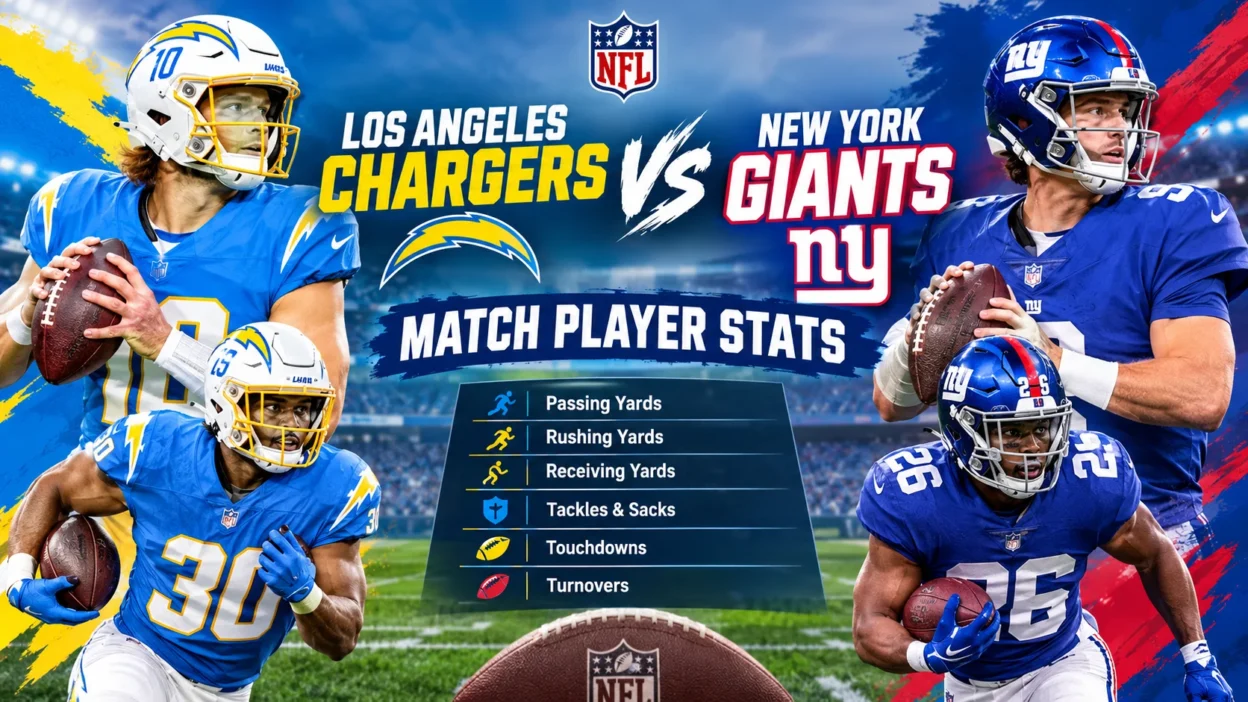
The Los Angeles Chargers vs New York Giants match player stats help football fans understand how individual players perform in this NFL matchup. By reviewing passing yards, rushing attempts, receiving yards, touchdowns, tackles, sacks, and turnovers, readers can see which players made the biggest impact and how their performances influenced the game.
If you follow the Chargers, support the Giants, or simply enjoy NFL statistics, understanding the box score makes every game easier to analyze. Quarterback efficiency, running back production, wide receiver contributions, and defensive pressure all help explain why a team wins or loses. However, the exact statistics depend on the game date and season, so it is important to identify the correct matchup before reporting individual numbers.
This guide explains how to read the player statistics for Los Angeles Chargers vs New York Giants, which categories matter most, how to compare both teams, and how to interpret the numbers accurately. It also provides examples to help beginners understand common NFL statistics without confusing hypothetical figures with official match results.
Quick Answer
Los Angeles Chargers vs New York Giants match player stats include passing yards, completions, rushing yards, receptions, receiving touchdowns, tackles, sacks, interceptions, and fumbles. The official game box score provides the most reliable figures. To identify the leading performers accurately, match the statistics to the specific game date and season.
Why Do Fans Compare These Two Teams’ Player Stats?
Fans compare the Chargers and Giants because the final score alone does not explain the entire game. Individual statistics reveal which players controlled the ground game, created passing opportunities, pressured the quarterback, or made crucial defensive stops.
In their September 28, 2025, meeting at MetLife Stadium, the New York Giants defeated the Los Angeles Chargers 21–18. The Giants gained 250 total yards, while the Chargers gained 338. Despite producing more total offense, Los Angeles committed two turnovers, compared with none for New York.
pro-football-reference.com
+1
This matchup demonstrates why player statistics should be evaluated alongside the score, turnovers, and key plays.
Los Angeles Chargers Player Stats
Justin Herbert — Quarterback
Justin Herbert completed 23 of 41 passes for 203 yards, one touchdown, and two interceptions. He also rushed once for 24 yards. His passing performance showed that the Chargers could move the ball, but the interceptions proved costly.
pro-football-reference.com
+1
Omarion Hampton — Running Back
Omarion Hampton was one of the game’s most productive offensive players. He rushed 12 times for 128 yards and one touchdown, averaging 10.7 yards per carry. His longest run covered 54 yards. He also caught five passes for 37 yards.

NFL
+1
Quentin Johnston — Wide Receiver
Quentin Johnston led the Chargers in receiving production, recording eight catches on 13 targets for 98 yards and one touchdown. His longest reception was 36 yards, giving the Chargers an important scoring play before halftime.
NFL
+1
Chargers Defensive Standouts
Defensive lineman Tuli Tuipulotu delivered an outstanding performance, recording four sacks, 10 tackles, and one forced fumble, according to FOX Sports’ game report. His pressure disrupted the Giants’ passing game, even though New York secured the victory.
FOX Sports
+1
New York Giants Player Stats
Jaxson Dart — Quarterback
Jaxson Dart made his first NFL start in this game and helped the Giants earn the win. He completed 13 of 20 passes for 111 yards, one passing touchdown, and no interceptions. He added 54 rushing yards and a rushing touchdown on 10 carries.
pro-football-reference.com
+1
Cam Skattebo — Running Back
Cam Skattebo carried the ball 25 times for 79 yards and caught two passes for 11 yards. He also contributed to the Giants’ second-half scoring sequence with a successful two-point conversion run. His workload helped New York sustain its ground attack.
pro-football-reference.com
+1
Theo Johnson — Tight End
Theo Johnson caught three passes for 17 yards and scored a receiving touchdown on a three-yard pass from Dart. That touchdown gave the Giants a crucial advantage in the third quarter.
pro-football-reference.com
+1
Chargers vs Giants Player Stats Comparison
The following table summarizes key offensive performances from the September 28, 2025, game.
| Category | Los Angeles Chargers | New York Giants |
|---|---|---|
| Final score | 18 | 21 |
| Passing leader | Justin Herbert: 203 yards | Jaxson Dart: 111 yards |
| Rushing leader | Omarion Hampton: 128 yards | Cam Skattebo: 79 yards |
| Leading receiver | Quentin Johnston: 98 yards | Darius Slayton: 44 yards |
| Passing touchdowns | 1 | 1 |
| Rushing touchdowns | 1 | 1 |
| Interceptions thrown | 2 | 0 |
| Total offensive yards | 338 | 250 |
| Total turnovers | 2 | 0 |
Sources: official NFL game statistics and published box scores.
NFL
+2
When Should You Use Each Player Statistic?
Different statistics answer different questions about an NFL game.
- Passing yards: Use this figure to evaluate how much passing offense a quarterback generated.
- Completion percentage: Use it to compare completed passes with total pass attempts.
- Rushing yards: Use this to measure ground-game production.
- Receiving yards: Use it to compare the distance gained by receivers after completed passes.
- Touchdowns: Use them to identify players who finished scoring plays.
- Interceptions: Use them to evaluate turnovers caused by intercepted passes.
- Sacks: Use them to measure defensive plays that bring down the quarterback behind the line of scrimmage.
- Tackles: Use them to understand a defender’s involvement in stopping the opposing offense.
No single statistic tells the complete story. A quarterback might throw for many yards but struggle with turnovers, while a running back might make fewer plays but produce a decisive touchdown.
10 Examples of How to Read Chargers vs Giants Player Stats
These examples use actual figures from the September 28, 2025, matchup to demonstrate how fans can interpret the box score.
pro-football-reference.com
+1
- Justin Herbert threw for 203 yards. This measures his passing production, not his team’s total offensive yards.
- Herbert completed 23 of 41 passes. His completion percentage was approximately 56.1%.
- Herbert threw one touchdown pass. One of his completed passes directly resulted in a passing touchdown.
- Herbert threw two interceptions. These turnovers helped explain why the Chargers lost despite gaining more total yards.
- Omarion Hampton rushed for 128 yards. He averaged 10.7 yards per carry, showing excellent production on his rushing attempts.
- Hampton scored one rushing touchdown. His score came on the ground rather than from a pass.
- Quentin Johnston caught eight passes. His eight receptions produced 98 receiving yards.
- Jaxson Dart rushed for 54 yards. His mobility added another dimension to the Giants’ offense.
- Dart scored a rushing touchdown. He ran 15 yards into the end zone during the first quarter.
- Theo Johnson caught a touchdown pass. His three-yard reception helped New York extend its lead in the third quarter.
- Tuli Tuipulotu recorded four sacks. This defensive statistic shows how frequently he brought down the opposing quarterback behind the line of scrimmage.
Common Mistakes When Reading NFL Player Stats
Readers sometimes misinterpret football statistics because similar categories measure different things.
- Confusing passing yards with total offense: Passing yards do not include rushing yards.
- Treating attempts as completions: A quarterback’s attempts include both completed and incomplete passes.
- Confusing receptions with targets: A target is a pass directed toward a receiver; a reception is a pass caught successfully.
- Ignoring turnovers: A team can gain more yards and still lose because of interceptions or lost fumbles.
- Mixing up individual and team totals: A quarterback’s passing yards and the team’s total offensive yards are different measures.
- Using statistics from the wrong game: Always confirm the season and date before publishing player numbers.
A Memory Trick for Understanding NFL Stats
Remember PASS, RUN, CATCH, DEFEND.
- PASS: Completions, attempts, passing yards, touchdowns, and interceptions.
- RUN: Carries, rushing yards, and rushing touchdowns.
- CATCH: Receptions, receiving yards, targets, and receiving touchdowns.
- DEFEND: Tackles, sacks, forced fumbles, and interceptions made by defenders.
This simple method helps beginners organize a box score and quickly identify the most important player performances.
American vs British English
NFL statistics use American football terminology, so American English is the natural choice for this topic.
| American football term | Meaning |
|---|---|
| Touchdown | A scoring play worth six points before any extra-point attempt |
| Yard | A unit used to measure field distance and player production |
| Quarterback | The offensive player who typically directs passing plays |
| Defense | The unit responsible for stopping the opposing offense |
| Rushing | Advancing the ball by running with it |
| Receiving | Catching passes thrown by a teammate |
British English readers can understand these terms without changing their spelling. However, British football generally refers to soccer, where these NFL statistics do not apply.
Similar NFL Statistics Worth Knowing
If you are researching Chargers vs Giants match player stats, these related measurements can provide more context.
- Quarterback rating: A passer-efficiency measure calculated using a specific formula. It is not the same as ESPN’s QBR.
- Yards per carry: Rushing yards divided by rushing attempts.
- Yards per reception: Receiving yards divided by catches.
- Yards per attempt: Passing yards divided by pass attempts.
- Red-zone efficiency: How effectively a team converts possessions inside the opponent’s 20-yard line into touchdowns or other scores.
- Time of possession: How long a team controls the ball during a game.
- Turnover differential: The difference between turnovers committed and turnovers forced.
Together, these measurements provide a clearer view of offensive efficiency, defensive pressure, and game management.
Final Verdict: Who Had the Better Player Performance?
The New York Giants won the September 28, 2025, matchup 21–18, but the Chargers produced more total offensive yards. Omarion Hampton led the rushing attack with 128 yards, Quentin Johnston led the Chargers in receiving with 98 yards, and Tuli Tuipulotu recorded four sacks. For New York, Jaxson Dart contributed both passing and rushing touchdowns.
FOX Sports
+1
The key lesson is that individual production and team success are not always the same. The Chargers gained more yards, but the Giants protected the ball better and made enough scoring plays to win.
FAQs:
1. Who won the Los Angeles Chargers vs New York Giants game?
The New York Giants won 21–18 on September 28, 2025, at MetLife Stadium in East Rutherford, New Jersey.
pro-football-reference.com
+1
2. How many passing yards did Justin Herbert record?
Justin Herbert recorded 203 passing yards, completed 23 of 41 attempts, threw one touchdown pass, and had two interceptions.
pro-football-reference.com
+1
3. How many rushing yards did Omarion Hampton have?
Omarion Hampton rushed for 128 yards on 12 carries and scored one rushing touchdown. He averaged 10.7 yards per carry.
NFL
+1
4. What were Jaxson Dart’s stats against the Chargers?
Jaxson Dart completed 13 of 20 passes for 111 yards, one passing touchdown, and no interceptions. He also rushed for 54 yards and one touchdown.
pro-football-reference.com
+1
5. Who led the Chargers in receiving yards?
Quentin Johnston led Los Angeles with eight receptions for 98 yards and one touchdown.
NFL
+1
6. Which defensive player recorded the most notable performance?
Chargers defender Tuli Tuipulotu recorded four sacks, 10 tackles, and one forced fumble, making him a standout defensive performer in the game.
FOX Sports
+1
7. Where can I find the official Chargers vs Giants box score?
You can review the game’s statistics on the
nfl.com
or visit the detailed
espn.com
. These resources provide game results and player statistics.
Remember This
- The Giants defeated the Chargers 21–18 on September 28, 2025.
- Omarion Hampton led the game in rushing yards with 128.
- Quentin Johnston led Chargers receivers with 98 receiving yards.
- Jaxson Dart contributed one passing touchdown and one rushing touchdown.
- Turnovers and scoring efficiency can matter more than total yardage.
Conclusion
The Los Angeles Chargers vs New York Giants match player stats show how individual performances shaped a close NFL contest. Hampton’s explosive rushing, Johnston’s receiving production, Herbert’s passing numbers, and Dart’s dual-threat ability all contributed to the game’s story. Tuipulotu’s defensive pressure also demonstrated how one player’s performance can stand out even in a defeat.
For accurate comparisons, always check the specific game’s official box score and consider passing, rushing, receiving, and defensive statistics together. Looking beyond the final score helps fans understand not only who won, but also how each team performed and which players made the biggest difference.

David Owen is a passionate writer and communication enthusiast dedicated to helping readers craft charming, witty, and thoughtful replies. Through ReplyCorner, he shares creative response ideas that make conversations engaging and memorable.