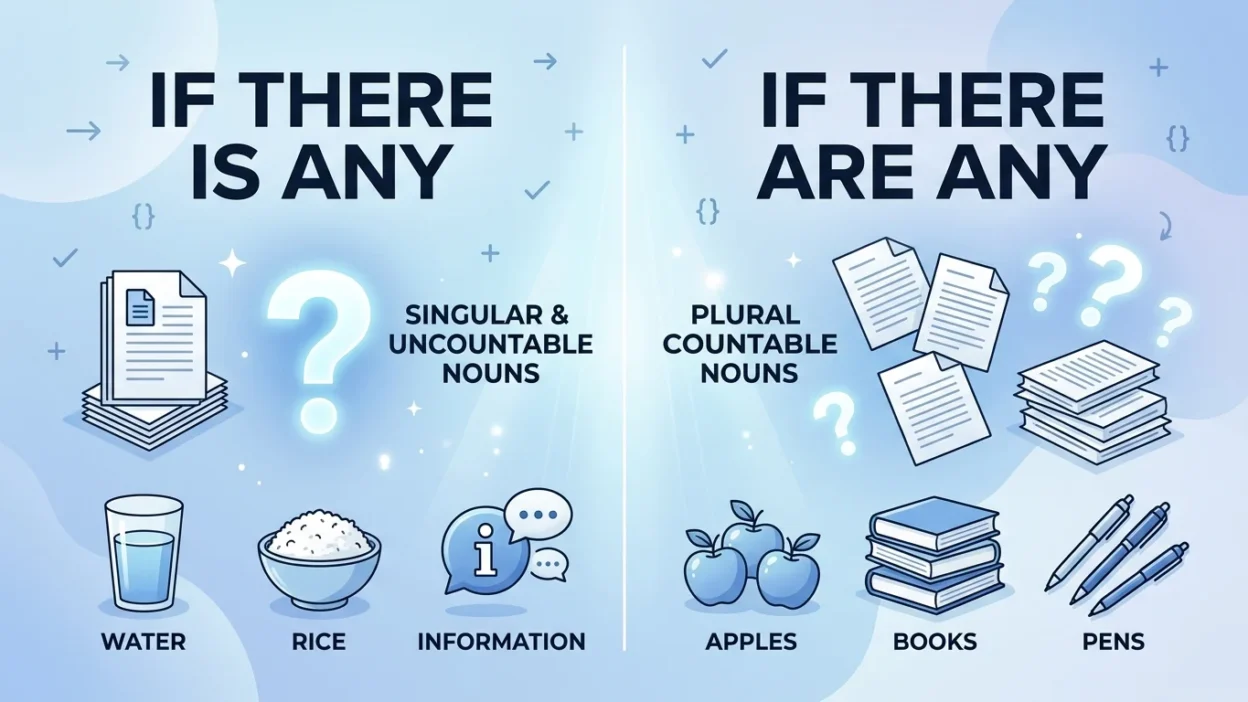
When choosing between “if there is any” and “if there are any,” the correct form depends on if the noun that follows is singular/uncountable or plural/countable. Use “if there is any” with singular or uncountable nouns, and “if there are any” with plural countable nouns.
For example, we say, “Let me know if there is any problem” because problem is singular. But we say, “Let me know if there are any problems” because problems is plural. The word any can work with both forms, so the important point is if the noun is singular, uncountable, or plural.
Quick Answer
“If there is any” is used with a singular or uncountable noun, while “if there are any” is used with plural countable nouns. For example, “if there is any information” and “if there are any questions.” The verb is/are agrees with the noun that follows.
Why Do People Confuse “If There Is Any” and “If There Are Any”?
The confusion happens because any can be used with both singular and plural nouns as well as uncountable nouns.
The verb is or are is not determined by any. Instead, it agrees with the noun.
- If there is any problem → singular noun
- If there are any problems → plural noun
- If there is any information → uncountable noun
- If there are any questions → plural noun
A useful way to choose the correct expression is to look at the noun immediately following it.
The First Word: “If There Is Any”
“If there is any” is correct when you are talking about a singular noun or an uncountable noun.
With singular nouns
- If there is any problem, let me know.
- Tell me if there is any mistake.
- Let me know if there is any reason to worry.
With uncountable nouns
- Let me know if there is any information available.
- Tell me if there is any water left.
- Ask if there is any money in the account.
Here, information, water, and money are uncountable nouns, so there is is used.
The Second Word: “If There Are Any”
“If there are any” is used with plural countable nouns.
Examples include:
- If there are any problems, tell me.
- Let me know if there are any questions.
- Check if there are any errors.
- Tell me if there are any changes.
Because problems, questions, errors, and changes are plural countable nouns, there are is required.
“If There Is Any” vs “If There Are Any”
| Expression | Used With | Example |
|---|---|---|
| If there is any | Singular nouns | If there is any problem, call me. |
| If there is any | Uncountable nouns | If there is any information, send it to me. |
| If there are any | Plural countable nouns | If there are any problems, let me know. |
| If there are any | Plural questions/items | If there are any questions, ask me. |
The key difference is singular/uncountable vs. plural countable.
When Should You Use “If There Is Any”?
Use “if there is any” when the noun is singular or uncountable.
Singular examples
- If there is any problem, please contact me.
- Let me know if there is any mistake in the document.
- Tell me if there is any reason to change the plan.
- Call me if there is any delay.
- Please report it if there is any issue.
- Let me know if there is any possibility of rain.
Uncountable examples
- Tell me if there is any information I should know.
- Let me know if there is any water left.
- Check if there is any money in the account.
- Ask if there is any evidence available.
- Let me know if there is any traffic on the road.
- Tell me if there is any additional work to do.
Notice that the nouns after any are not plural countable nouns.
When Should You Use “If There Are Any”?
Use “if there are any” when the noun is plural and countable.
Examples:
- If there are any problems, let me know.
- If there are any questions, please ask.
- Tell me if there are any mistakes.
- Let me know if there are any changes.
- Check if there are any errors in the report.
- Tell me if there are any updates.
- Let me know if there are any available seats.
- Ask if there are any discounts.
- Tell me if there are any alternatives.
- Check if there are any messages for me.
- Let me know if there are any concerns.
- Tell me if there are any other options.
Common Mistakes
1. Using “there is” with a plural noun
❌ If there is any problems, let me know.
✅ If there are any problems, let me know.
Problems is plural, so use there are.
2. Using “there are” with an uncountable noun
❌ If there are any information, tell me.
✅ If there is any information, tell me.
Information is normally uncountable, so use there is.
3. Thinking “any” always requires “are”
The word any does not determine if you use is or are.
Compare:
- If there is any information…
- If there are any questions…
The noun determines the verb.
4. Confusing singular and plural forms
Compare:
- If there is any problem…
- If there are any problems…
Both sentences are grammatical. The difference is simply problem vs. problems.
A Simple Memory Trick
Think:
One or uncountable → IS
More than one → ARE
So:
- any problem → there is
- any information → there is
- any questions → there are
- any problems → there are
A quick question to ask yourself is:
If it is singular or uncountable, choose is. If it is plural countable, choose are.
American vs. British English
The basic rule is the same in both American English and British English.
Both varieties use:
- If there is any information…
- If there are any questions…
- If there is any problem…
- If there are any problems…
There is no major American-versus-British difference in the grammatical agreement between there is and there are in these examples.
Similar Words and Expressions
Several expressions are closely related to “if there is any” and “if there are any.”
If there is something
Used when referring to an unspecified thing:
If there are some
Used when referring to multiple items:
If there is anything
Common when referring broadly to an unspecified thing or matter:
If there are any
Common when referring to multiple possible items:
Final Verdict
Both “if there is any” and “if there are any” are correct. The choice depends on the noun that follows.
Use “if there is any” with singular or uncountable nouns:
Use “if there are any” with plural countable nouns:
The important thing is not the word any itself. The verb is/are must agree with the noun.
FAQs:
Is “if there is any” grammatically correct?
Yes. “If there is any” is grammatically correct when it is followed by a singular or uncountable noun, such as problem, information, water, or money.
Is “if there are any” grammatically correct?
Yes. “If there are any” is correct when followed by a plural countable noun, such as questions, problems, mistakes, or changes.
Should I say “if there is any problem” or “if there are any problems”?
Both can be correct. “If there is any problem” refers to a problem in the singular, while “if there are any problems” refers to one or more possible problems.
Is it “if there is any questions” or “if there are any questions”?
The correct form is “if there are any questions.” Questions is a plural countable noun, so it takes are.
Is it “if there is any information” or “if there are any information”?
The correct form is “if there is any information.” Information is normally an uncountable noun in English.
Can “any” be used with singular nouns?
Yes. Any can be used with singular countable nouns in certain contexts, especially when referring to an unspecified member of a group.
What is the easiest way to remember the difference?
Look at the noun after any. Use there is with a singular or uncountable noun and there are with a plural countable noun.
Remember This
Singular or uncountable noun → “if there is any”
Plural countable noun → “if there are any”
Any does not decide the verb. The noun does.
Conclusion
The expressions “if there is any” and “if there are any” are both correct, but they are used with different types of nouns. Use “if there is any” with singular or uncountable nouns and “if there are any” with plural countable nouns.
When you are unsure, look at the noun that follows any. If it is one thing or something uncountable, use is. If it refers to multiple countable things, use are. This simple rule will help you choose the correct expression naturally and confidently.

David Owen is a passionate writer and communication enthusiast dedicated to helping readers craft charming, witty, and thoughtful replies. Through ReplyCorner, he shares creative response ideas that make conversations engaging and memorable.