
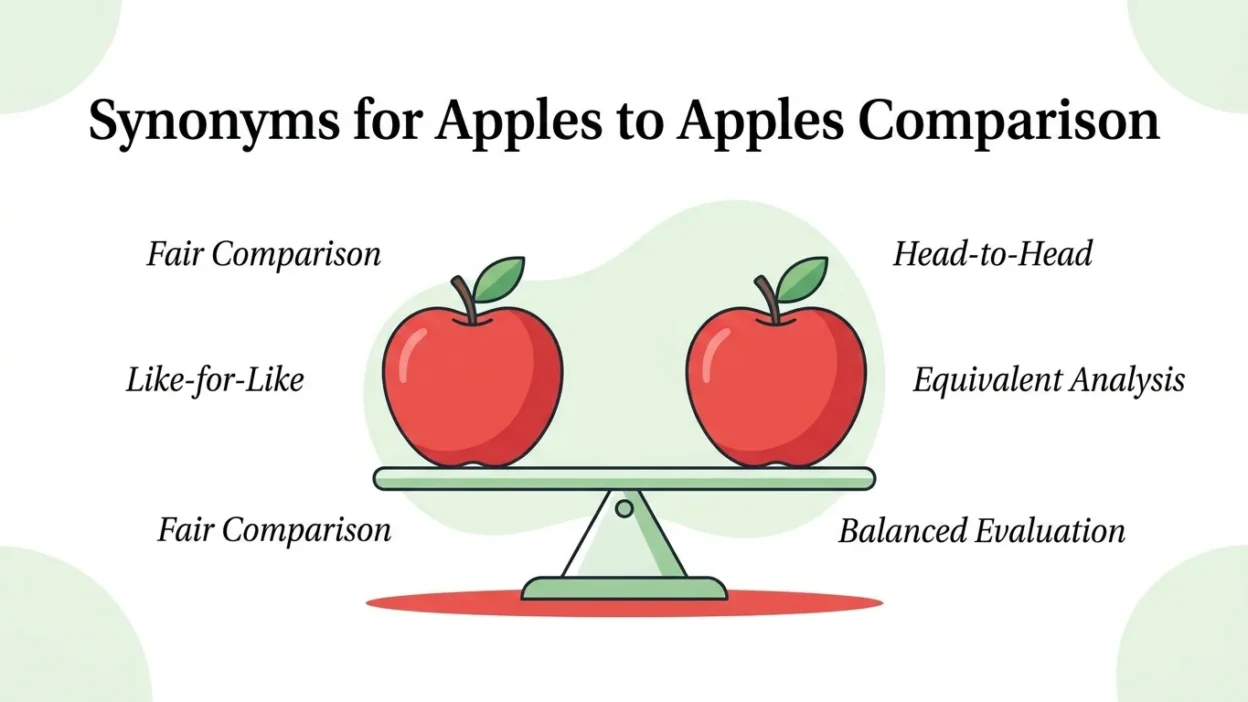
The phrase “apples to apples comparison“ is commonly used when comparing two things that are similar enough to evaluate fairly. IF you’re writing a business report, academic paper, blog post, or having a casual conversation, using different ways to express this idea can make your writing more engaging and less repetitive.
If you’re looking for synonyms for apples to apples comparison, you’ve come to the right place. This guide explores 30 excellent alternatives, explains when to use them, and provides practical examples to help you choose the perfect phrase for any situation. You’ll also discover related expressions, comparison phrases, and equivalent terms that improve clarity and style.
1. Fair Comparison
Best for: General conversations and formal writing
Alternative: Equal comparison
Examples:
- We need a fair comparison before choosing the better product.
- The study offers a fair comparison between both methods.
A fair comparison ensures both subjects are evaluated under similar conditions.
2. Like-for-Like Comparison
Best for: Business and finance
Alternative: Equivalent comparison
Examples:
- The report uses a like-for-like comparison of yearly sales.
- Investors prefer like-for-like comparisons when reviewing growth.
This phrase is especially popular in retail and financial reporting.
3. Equal Comparison
Best for: Academic writing
Alternative: Balanced comparison
Examples:
- The experiment requires an equal comparison of variables.
- The teacher encouraged an equal comparison of both theories.
It emphasizes fairness and consistency.
4. Direct Comparison
Best for: Product reviews
Alternative: Side-by-side comparison
Examples:
- A direct comparison reveals the differences quickly.
- The article includes a direct comparison of smartphones.
This phrase highlights a straightforward evaluation.
5. Side-by-Side Comparison
Best for: Visual presentations
Alternative: Parallel comparison
Examples:
- The website offers a side-by-side comparison chart.
- Compare both laptops side by side before buying.
Perfect for highlighting similarities and differences.
6. Equivalent Comparison
Best for: Technical writing
Alternative: Comparable evaluation
Examples:
- The researchers used an equivalent comparison.
- Equivalent comparisons improve accuracy.
It suggests matching similar standards.
7. Balanced Comparison
Best for: Essays
Alternative: Fair evaluation
Examples:
- The review provides a balanced comparison.
- Balanced comparisons reduce bias.
Useful when neutrality matters.
8. Objective Comparison
Best for: Research
Alternative: Unbiased comparison
Examples:
- An objective comparison supports better decisions.
- The analysis remained objective throughout.
Focuses on facts rather than opinions.
9. Parallel Comparison
Best for: Reports
Alternative: Side-by-side evaluation
Examples:
- The report includes a parallel comparison.
- Parallel comparisons simplify analysis.
Ideal for comparing multiple factors.
10. Comparable Evaluation
Best for: Professional writing
Alternative: Equivalent assessment
Examples:
- Conduct a comparable evaluation before investing.
- The committee requested a comparable evaluation.
Highlights equal standards.
11. Even Comparison
Best for: Casual discussions
Alternative: Fair matchup
Examples:
- That’s an even comparison.
- Make the comparison even by using the same criteria.
Easy and conversational.
12. Matching Comparison
Best for: Data analysis
Alternative: Like-for-like review
Examples:
- The analyst created a matching comparison.
- Matching comparisons improve reliability.
Useful when variables align closely.
13. Similarity Comparison
Best for: Educational contexts
Alternative: Comparable analysis
Examples:
- The assignment required a similarity comparison.
- Similarity comparisons reveal patterns.
Helps identify common features.
14. Comparable Analysis
Best for: Research papers
Alternative: Relative analysis
Examples:
- The journal includes a comparable analysis.
- Comparable analysis strengthens conclusions.
Widely accepted in formal writing.
15. Fair Evaluation
Best for: Performance reviews
Alternative: Balanced assessment
Examples:
- Every employee deserves a fair evaluation.
- The judge conducted a fair evaluation.
Emphasizes impartiality.
16. Balanced Assessment
Best for: Workplace communication
Alternative: Objective review
Examples:
- Managers should perform balanced assessments.
- The balanced assessment impressed stakeholders.
Promotes fairness.
17. Objective Review
Best for: Editorial writing
Alternative: Neutral evaluation
Examples:
- The magazine offers an objective review.
- Readers appreciate objective reviews.
Ideal for trustworthy content.
18. Neutral Comparison
Best for: Scientific studies
Alternative: Unbiased analysis
Examples:
- The researchers maintained a neutral comparison.
- Neutral comparisons increase credibility.
Avoids favoritism.
19. Relative Comparison
Best for: Statistics
Alternative: Comparative analysis
Examples:
- Relative comparison explains percentage growth.
- The report uses relative comparison effectively.
Useful for numerical evaluations.
20. Comparative Analysis
Best for: Business strategy
Alternative: Detailed comparison
Examples:
- Comparative analysis guided the decision.
- Businesses rely on comparative analysis.
A formal alternative.
21. Equal Evaluation
Best for: Education
Alternative: Fair assessment
Examples:
- Students deserve equal evaluation.
- Equal evaluation ensures consistency.
Supports equal treatment.
22. Standardized Comparison
Best for: Research
Alternative: Uniform comparison
Examples:
- The study uses standardized comparison methods.
- Standardized comparisons reduce errors.
Maintains consistency.
23. Uniform Comparison
Best for: Testing
Alternative: Standard comparison
Examples:
- Uniform comparisons produce reliable data.
- Use uniform comparisons across samples.
Ideal for controlled studies.
24. Consistent Comparison
Best for: Analytics
Alternative: Stable evaluation
Examples:
- Consistent comparisons improve reporting.
- Analysts prefer consistent comparisons.
Helps maintain accuracy.
25. Equivalent Assessment
Best for: Corporate reports
Alternative: Comparable review
Examples:
- The board requested an equivalent assessment.
- Equivalent assessments improve transparency.
Works well in formal documents.
26. Level Playing Field Comparison
Best for: Sports and business
Alternative: Fair contest
Examples:
- Regulations create a level playing field comparison.
- The policy ensures a level playing field.
Emphasizes equal opportunity.
27. Head-to-Head Comparison
Best for: Product reviews
Alternative: Direct matchup
Examples:
- This article offers a head-to-head comparison.
- The head-to-head comparison favors Model A.
Popular in comparison guides.
28. One-to-One Comparison
Best for: Technology reviews
Alternative: Direct evaluation
Examples:
- We conducted a one-to-one comparison.
- The one-to-one comparison revealed key differences.
Simple and effective.
29. Fair Matchup
Best for: Informal writing
Alternative: Equal contest
Examples:
- That’s a fair matchup.
- The debate was a fair matchup of ideas.
Friendly and conversational.
30. Comparable Match
Best for: Everyday communication
Alternative: Similar comparison
Examples:
- These brands are a comparable match.
- It’s a comparable match based on quality.
A flexible phrase for many contexts.
Conclusion
Finding the right synonyms for apples to apples comparison can make your writing more dynamic, professional, and engaging. If you’re preparing a business report, writing an academic paper, or creating online content, using alternatives like fair comparison, like-for-like comparison, head-to-head comparison, and comparable analysis helps avoid repetition while improving clarity.
Choose the phrase that best matches your audience and context, and your comparisons will sound more natural and persuasive.
FAQ
1. What does “apples to apples comparison” mean?
It means comparing two things that are similar enough to be evaluated fairly using the same standards.
2. What is the best synonym for apples to apples comparison?
“Fair comparison” and “like-for-like comparison” are among the most commonly used alternatives.
3. Is “head-to-head comparison” the same as apples to apples comparison?
Yes, in many contexts it refers to a direct evaluation between two comparable options.
4. Can I use “comparable analysis” in academic writing?
Absolutely. It is a formal and widely accepted alternative suitable for research papers and reports.
5. Why should I use different synonyms instead of repeating the same phrase?
Using varied comparison phrases improves readability, enhances SEO, and keeps your writing engaging for readers.

David Owen is a passionate writer and communication enthusiast dedicated to helping readers craft charming, witty, and thoughtful replies. Through ReplyCorner, he shares creative response ideas that make conversations engaging and memorable.